A graphic design project that takes visitors from the soil to the jaguar, using scroll to show what happens when links in the Cerrado food web come under pressure.
Rudo Studios · 2026-11-17
Open the interactive experience in English
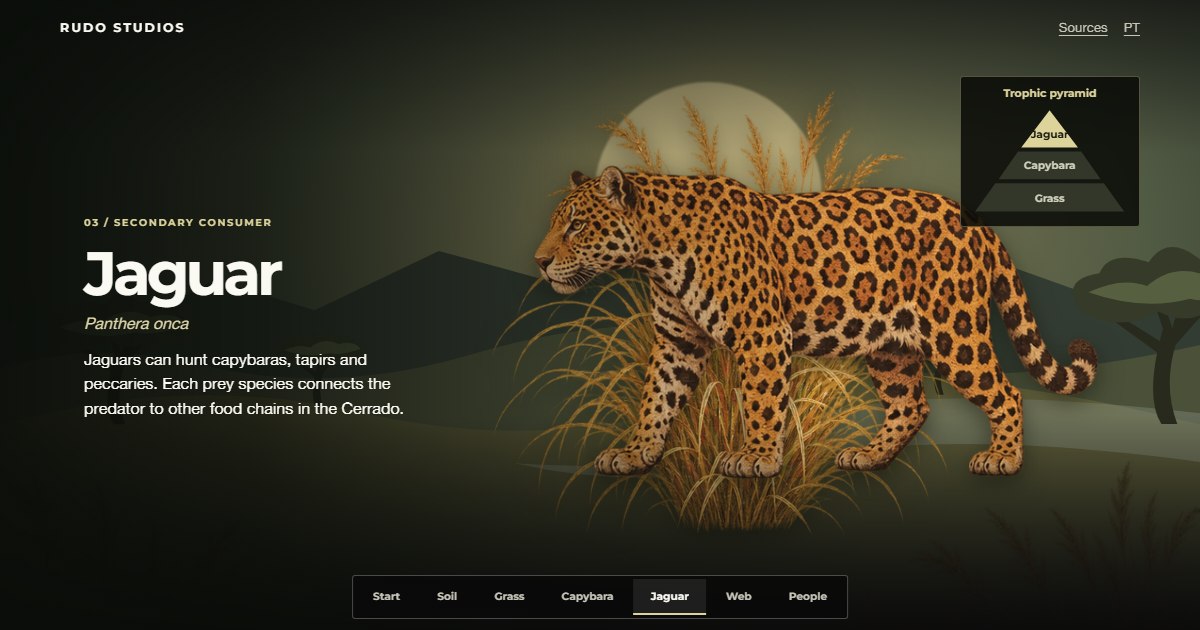
How do you show the difference between a food chain and a food web without opening with a diagram full of arrows? In The Cerrado’s Living Food Web, the first design decision was to follow a single path. Visitors start underground, move through grasses and capybaras, and reach the jaguar. The view then widens to reveal other relationships and what changes under human pressure.
One landscape, several points of view
The scene stays in place as scrolling changes what comes into the foreground. The grass gives way to the capybara. The jaguar enters on another layer. Because the animals and vegetation are separate cutouts, each element can move independently of the landscape. The studio’s typography and dark interface provide continuity, while colour and motion mark the transitions.
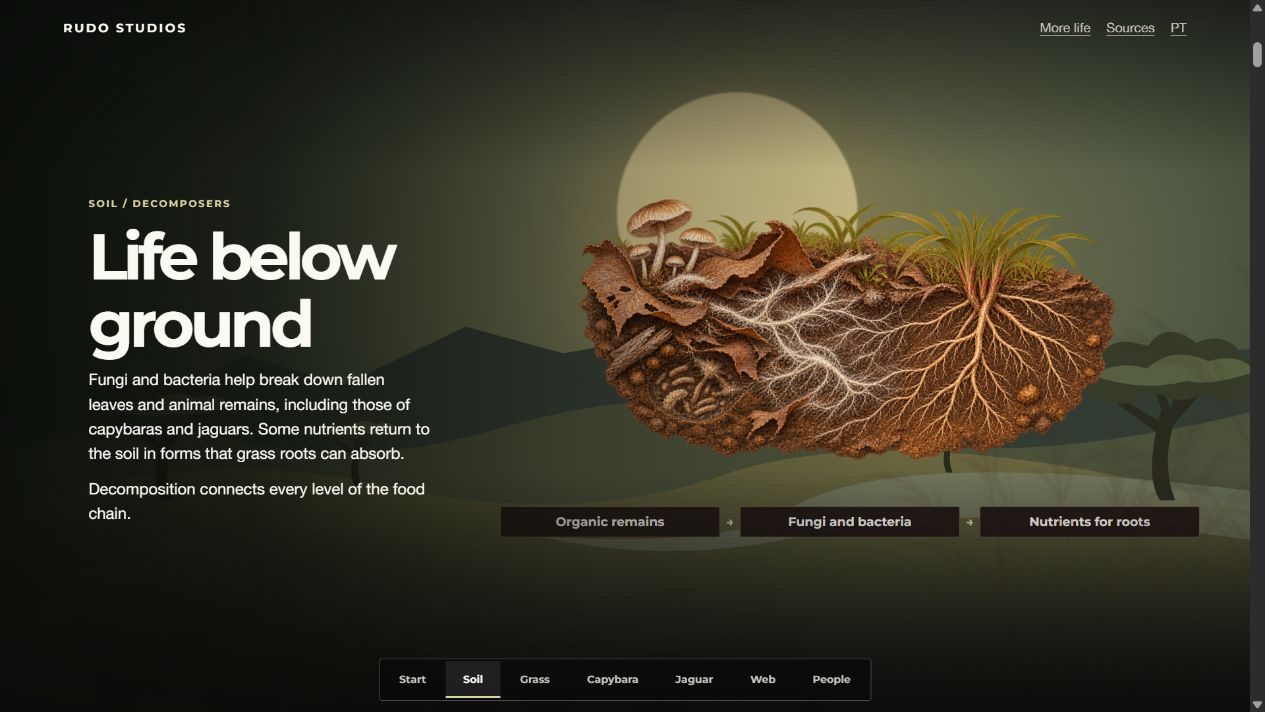
The trophic pyramid reverses the direction of travel. As visitors scroll down, the highlight moves up: producer, primary consumer, secondary consumer. The soil sits outside those three steps because decomposition connects them all. Fungi and bacteria break down plant and animal remains, making some of their nutrients available to roots again.
The same place under pressure
The impact section repeats the composition so visitors can compare scenarios. They can see where a clearing opens up, where a road goes through, and which animals fade. Dashed lines mark relationships under pressure. These qualitative changes show where a disturbance first affects the web. The illustration functions as a teaching diagram.
Wildfire closes the impact sequence. The ground darkens along with the landscape, returning to the life in the soil that opened the story. Intense wildfires can also affect microbial communities at the surface. Their effects depend on the fire regime, and the experience distinguishes uncontrolled wildfires from planned burns used to manage parts of the Cerrado.
The same page, more animals and voices
After the initial food chain and the section showing how the web breaks, animal discovery unfolds through scrolling. The scene stays in view while the maned wolf, giant anteater, Brazilian merganser and helmeted manakin enter one at a time, accompanied by their scientific names and context. Observation flows without recognition buttons; questions belong to the quizzes. All 32 names remain in the search cloud.
The cloud offers all 32 names across seven real Google Trends comparisons. Each group keeps its own scale: the composition highlights the terms from one comparison at a time, without combining incompatible indices into an overall ranking. Original exports and the Brazilian scope are available for inspection.
The silhouette quiz turns the journey into six questions, shown one at a time. Before answering, visitors see the animal’s outline and scientific name. They choose its common name; after an answer, the silhouette becomes the full-colour illustration and the correct name is revealed. Each round has one scored attempt.
The listening quiz closes the journey with four rounds, using real recordings of the rufous hornero, southern lapwing, rufous-bellied thrush and toco toucan. Each answer reveals the bird, vocalisation type, creator, credited location and licence. The recordings are not presented as field recordings made in the Cerrado. The QR code opens this part of the same page directly. The sequence is now explicit: initial food chain, disruption of the web, more names, Google searches, silhouettes and sounds.
Sources and credits
- Brasília Ambiental — capybara characteristics and diet.
- Embrapa — decomposition of organic matter in the Cerrado.
- Research on Cerrado soil microbes after wildfires.
Project and screenshots by Rudo Studios. The animal, grass, soil and human illustrations were created with AI assistance. Fungi and bacteria in the soil illustration are enlarged for visibility; elements are not shown at the same scale.