Before Zaha Hadid became a global name, one small concrete fire station in Germany proved that her radical drawings could become architecture.
Matheus Rudo Oliveira · 2026-11-02
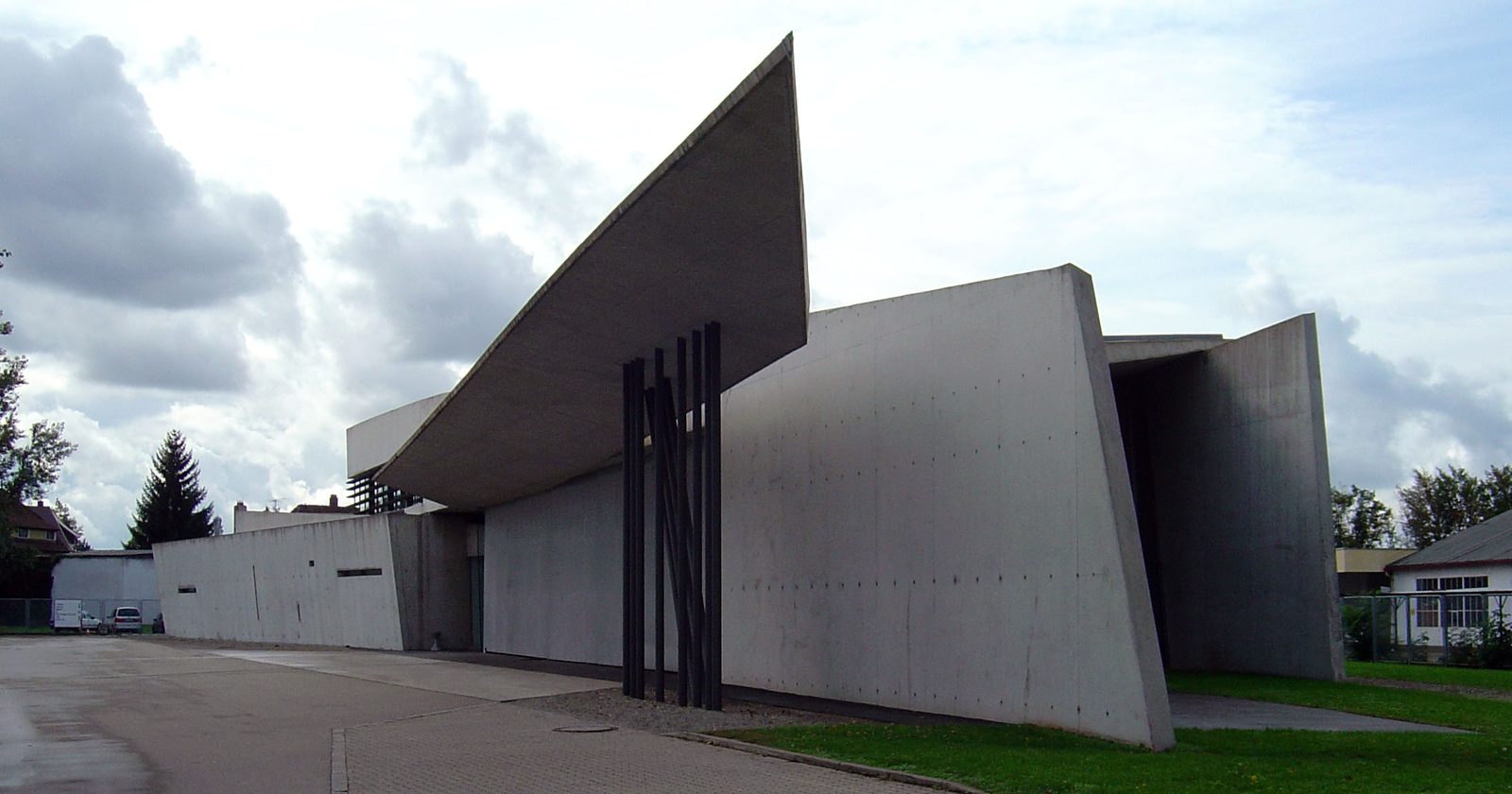
Zaha Hadid's Vitra Fire Station: The Building That Turned Motion Into Concrete
Zaha Hadid's Vitra Fire Station became famous for a rare reason: it proved that an architecture many people knew first through drawings, paintings, and speculative forms could be built.
Completed in 1993 on the Vitra Campus in Weil am Rhein, Germany, the project was not a museum or monument. It was a compact building for Vitra's company fire brigade. Yet it became one of the key early works in Hadid's career.
A Fire Station About Movement
Vitra commissioned the building after a major fire in 1981. The brief included practical spaces for fire engines, showers, changing rooms, a conference room, and a kitchenette.
Hadid treated that practical program as a spatial problem. Instead of a familiar firehouse with a clear front and service bay, she designed a sharp concrete composition that seems to stretch and brace itself along the site.
Hadid's First Built Breakthrough
Vitra describes the project as the first building complex designed by Zaha Hadid. Zaha Hadid Architects lists it as a 1990-1993 project for Vitra International AG.
That matters because Hadid was already respected for drawings, competition entries, and theoretical work. The Fire Station gave that reputation a built anchor. It showed that fragmented geometry and dynamic space could become walls, doors, glazing, concrete edges, and inhabitable rooms.
Movement Frozen in Concrete
Zaha Hadid Architects describes the building as a representation of "movement frozen." The phrase fits because the design does not decorate motion. It suggests motion through compression, alignment, angled walls, and long concrete planes.
The material is central. Vitra notes that the building was cast in concrete on site, and Zaha Hadid Architects describes it as exposed reinforced in-situ concrete. Concrete often feels heavy, but here it becomes precise, tense, and directional.
Why It Still Feels Fresh
The building no longer functions as a fire station. Vitra says the company later disbanded its internal fire brigade, and the rooms are now used for events and exhibitions by the Vitra Design Museum.
That change makes the project more interesting, not less. A building designed around alertness and emergency movement is now studied as architecture. Its original function changed, but its design lesson remains clear.
The Fire Station shows that a small building can carry a large architectural idea. It also shows that function does not have to produce generic form. Hadid turned a utilitarian brief into a study of speed, readiness, site, and force.
Final Thought
The Vitra Fire Station matters because it made a difficult architectural idea physically real. It turned alertness into geometry, movement into concrete, and a modest industrial brief into a building that still teaches designers how much energy can be hidden inside a wall.
Loved this topic? Keep exploring Hadid's world through Zaha Hadid: Complete Works and compare how her early angular language evolved into later fluid architecture.
Wikimedia Commons (ver arquivo original).