The YY Chair presentation board shows how the arms, seat and base read as one continuous form, and what a prototype could establish.
Matheus Rudo Oliveira · 2026-11-12
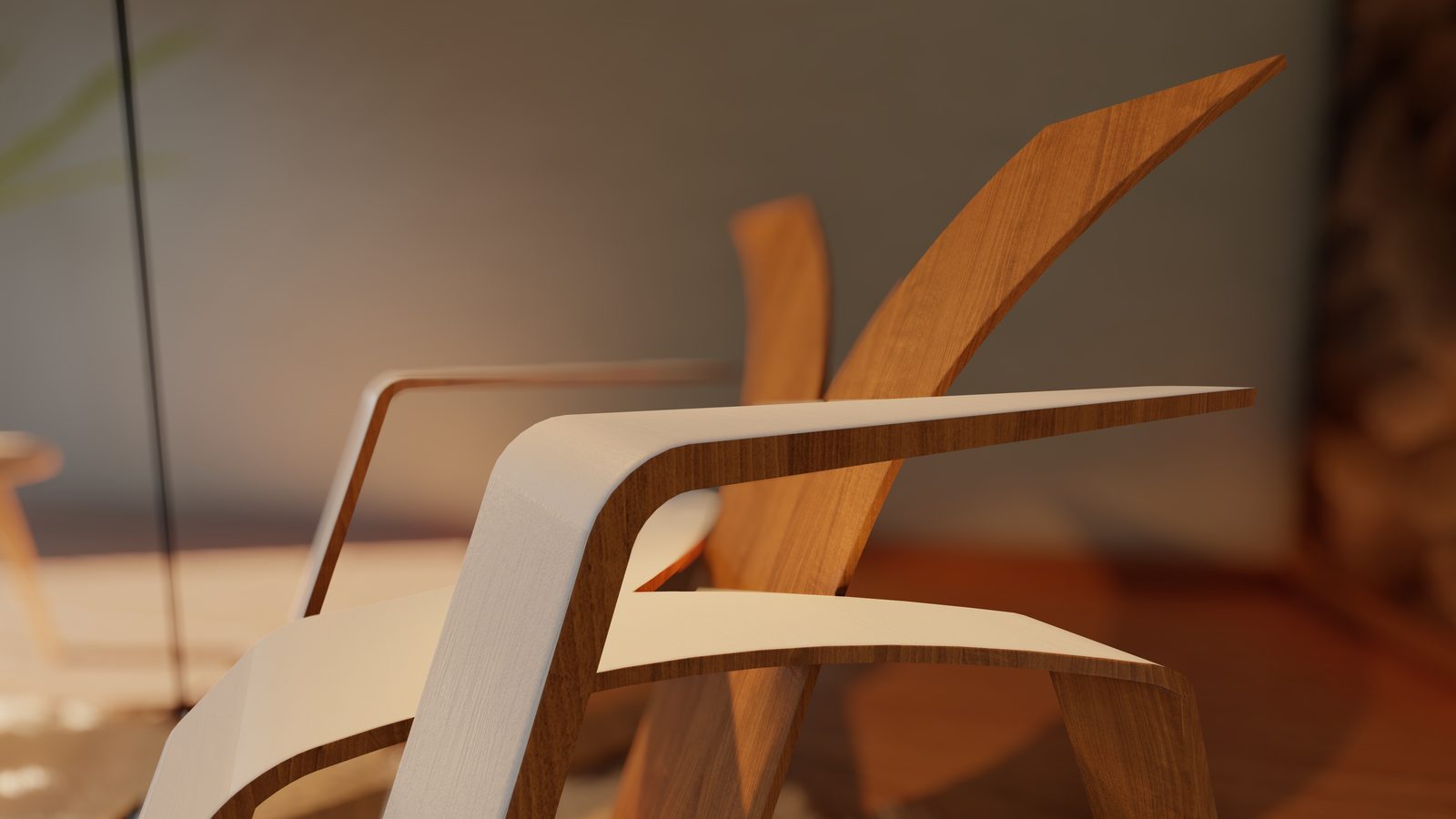
Seen from the front, the YY Chair opens into a Y above the seat. From the side, the armrest extends forward, turns down and meets the base. The Rudo Studios presentation board describes the concept as a single folded sheet of wood. Switching between the views shows how that idea organizes the surfaces that meet the body and the floor.
What the drawings show
The front elevation gives an overall height of 1.10 m and a width of 1.00 m. The armrests are 0.76 m high and the seat is 0.48 m high. The side elevation gives a depth of 1.10 m and shows the opening beneath the seat. In the perspective view in the gallery below, that opening separates two curves that overlap in profile: the downward turn of the armrest and the seat folding towards the base. The edges make the surfaces read as continuous where a chair built from separate pieces would typically have joints.
What the choice of CLT entails
The board identifies the material as cross-laminated timber, or CLT. In construction, the term refers to bonded panels with layers that alternate in direction. The APA describes the typical layup, the American Wood Council explains layer orientation, and APA specification guide covers panel selection for buildings.
The board shows the intended geometry. Fabrication would require decisions about layer thickness and orientation, bend radii and the forming process. A cross section through the folds would show how the layers follow each curve.
What a prototype could establish
The profile suggests two tests. Under a seated load, the question is how much the seat deflects between the curves that carry it to the base. When someone pushes down on an armrest to get up, the questions are how much it flexes and whether the base stays in contact with the floor. The seat height and angle would also need to be tried by people of different heights. The board presents comfort and a smaller environmental footprint as aims. An environmental comparison would require data on the wood, adhesive, fabrication and service life.
Explore other studio projects in the furniture design portfolio.