Fallingwater brings landscape into the structure of a house. Its terraces also reveal why architectural ambition requires lasting responsibility for maintenance.
Matheus Rudo Oliveira · 2026-11-01
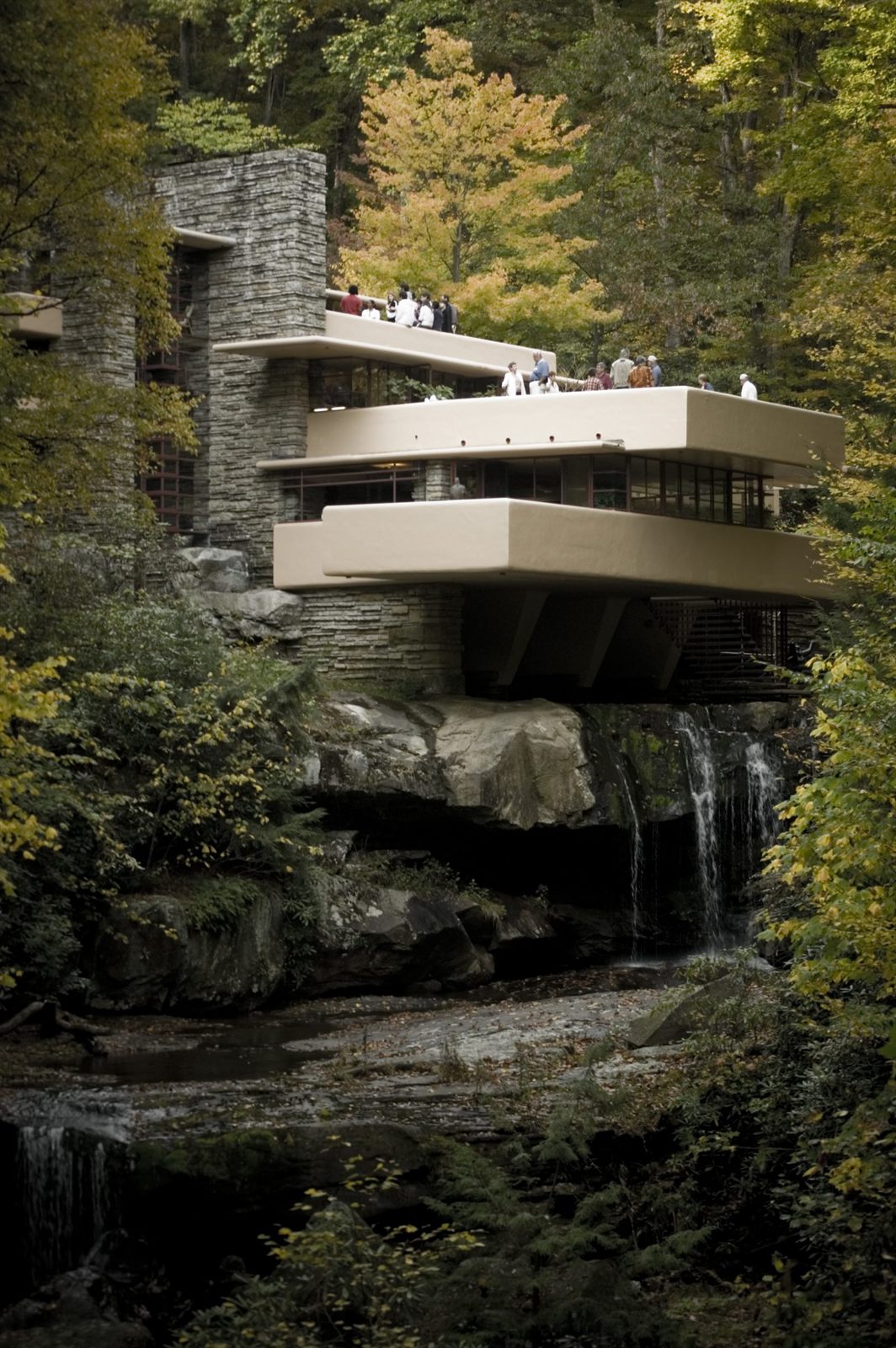
Frank Lloyd Wright's Fallingwater is famous enough to feel familiar before you ever visit it: concrete terraces, stone walls, forest, and water moving under the house. But the reason it still feels radical is simple. Wright placed the Kaufmann family's weekend house over the waterfall, not beside it.
That decision changed the building from a scenic retreat into an architectural event. Fallingwater is not a house with a nice view of nature. It is a house built into sound, spray, rock, shadow, and risk.
A Weekend House That Became a Landmark
Fallingwater was designed for Edgar J. Kaufmann, Liliane Kaufmann, and their family at Bear Run in Mill Run, Pennsylvania. The official timeline records the Kaufmanns approaching Wright after a visit to Taliesin in 1934. Construction began in April 1936; the family moved into the completed main house in December 1937. The guest house followed in 1939. These dates distinguish the initial relationship, construction and occupation: the building's history cannot be reduced to a single anniversary.
The site already mattered to the family. Wright's move was to make that attachment physical. The stream, ledges, trees, and changing weather are not background scenery. They shape how the rooms feel and how the house is remembered.
Why the Design Still Works
Many houses frame landscape from a safe distance. Fallingwater compresses the distance. Its reinforced concrete terraces project outward, while the stone core anchors the building to the rocks of Bear Run. Horizontal lines echo natural ledges, and the constant sound of water changes the atmosphere inside.
This is the practical meaning of Wright's organic architecture. It is not about making a building disappear into nature. It is about letting form, material, movement, and place depend on each other.
The UNESCO account of Wright's architecture connects organic architecture with open plans, continuity between interior and exterior, and new uses of steel and concrete. Fallingwater belongs to that group of eight buildings. Its inclusion offers context for the design; it does not remove the need to examine how this particular house works.
Reading the photograph beyond the silhouette
In Sxenko's photograph above, the pale parapets make the terraces read as horizontal bands. Between them, dark glazing recedes into shadow. The stonework has a different rhythm: its many thin courses accumulate into vertical masses. Together, these contrasts make the terraces seem to extend from something heavier and more rooted.
The waterfall matters to that reading. Below the lowest terrace, the rock and falling water prevent the apparent lightness of the concrete from becoming an abstract composition. The image puts the span and the drop in the same frame. This is a visual analysis of the documented building, rather than an account of a visit or a substitute for structural drawings.
The Beauty and the Problem Are Connected
Fallingwater also teaches a harder lesson: ambitious architecture needs care. Water, humidity, flat roofs, concrete, steel, stone, and dramatic cantilevers all create long-term preservation challenges.
The preservation history maintained by Fallingwater documents water infiltration and freeze-thaw damage, as well as the strengthening of the living-room cantilevers in 2001–2002. The technical problem was real. Admiring the projecting terraces should not turn their structural difficulties into a virtue or treat repair as an invisible footnote.
Pamela Jerome's conservation presentation published by the National Park Service adds another scale of responsibility: the steel windows, doors and stair to the stream. She describes corrosion, failed repair trials and the use of stainless-steel supports for the stair. Preserving an architectural idea involves decisions about individual joints and components, as well as the overall silhouette.
The lesson is not that every daring span should be repeated. It is that a design decision carries obligations beyond the photograph. Water, material performance and access for repair belong in the discussion of architectural quality. Fallingwater is a demanding work that survives through continuing study and intervention.
What Architects Can Learn
Fallingwater remains useful because its lessons are clear. Design the experience, not just the view. Let materials belong to the site. Accept that bold ideas may require long-term responsibility. Most of all, understand that a building becomes memorable when its concept can be felt in the body.
For a contemporary project, this means asking two questions together: what relationship with the site does the building create, and what will be required to sustain that relationship? A terrace may bring a room closer to water while making drainage, waterproofing and inspection more consequential. The spatial benefit and the maintenance obligation should be evaluated together.
Compare this relationship with the stone, filtered light and open-air routes of Taliesin West. The two works invite a reading of organic architecture through different sites, rather than a single visual recipe. More essays are collected in the studio's architecture section.
A Landscape Impossible to Ignore
Fallingwater remains radical because it refuses to separate architecture from place. Wright did not simply add a house to a landscape. He made the landscape impossible to ignore.
Sources and image credit
- Fallingwater / Western Pennsylvania Conservancy: Timeline and Preservation History.
- UNESCO World Heritage Centre: The 20th-Century Architecture of Frank Lloyd Wright.
- National Park Service: Pamela Jerome on the restoration and replication of steel elements.
Photograph: Sxenko, Wrightfallingwater.jpg, Wikimedia Commons, under CC BY 3.0. The website uses a reduced-resolution version of the photograph.

Editorial revision and Portuguese translation produced with AI support, checked against the sources listed above. No in-person visit is claimed.