A competition house in Japan that treats the void — 空 — as a design material: a core that anchors the building to the ground and a light envelope that mirrors the sky from below.
Matheus Rudo Oliveira · 2026-11-01
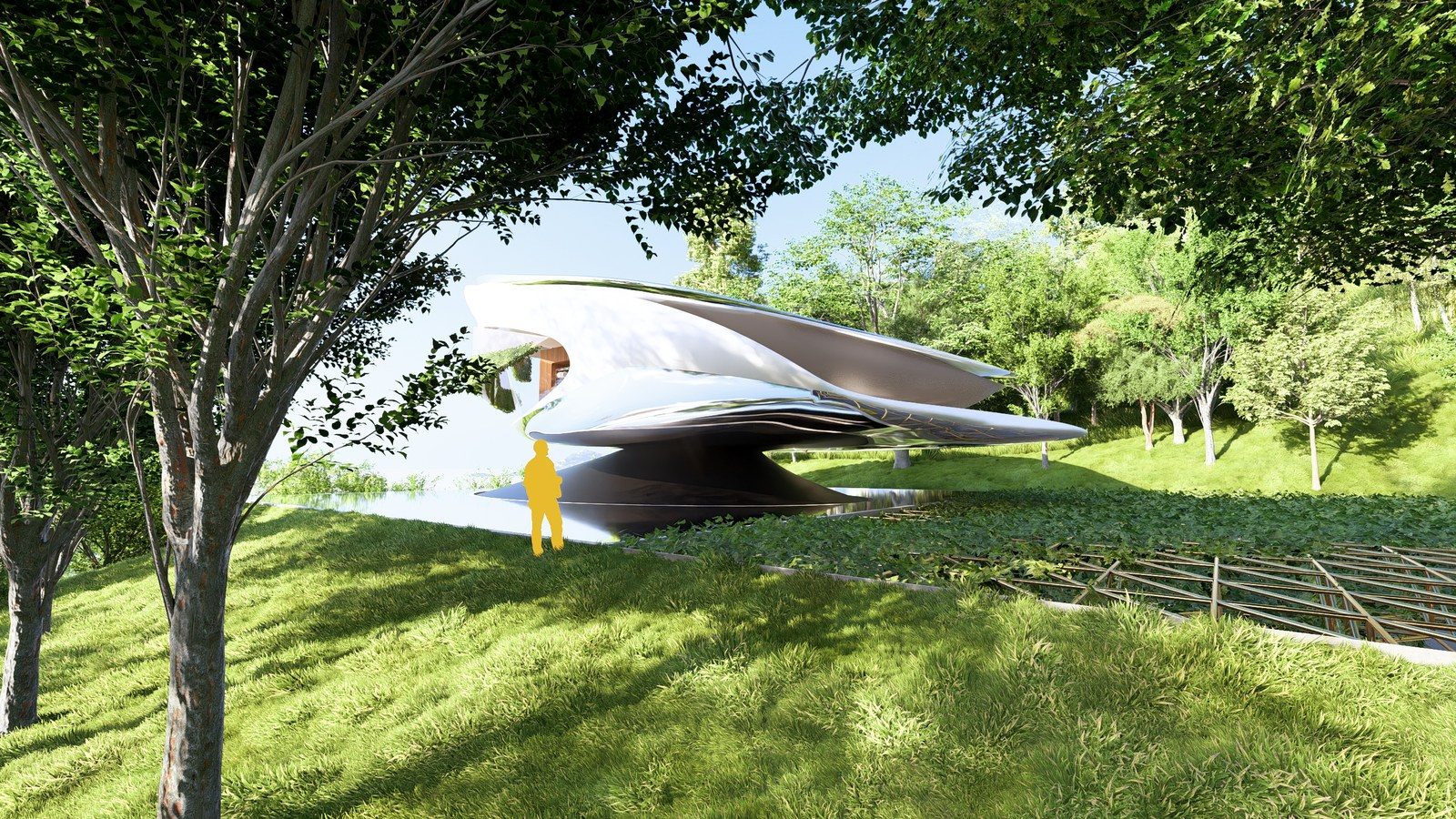
Every culture chooses a material to start designing from. In Japan, one of them is the void. The character 空 — read sora when it means sky and ku when it means emptiness, opening — carries at once the idea of vastness, of absence and of freedom. This project starts from that double meaning and turns it into geometry.
From stroke to volume
The brush gesture that writes 空 is continuous: a stroke that changes thickness, folds and breathes without lifting from the page. The proposal translates that behaviour into surfaces that do not interrupt each other — a curved envelope in which roof and façade are the same line.
What is sought is not a building resting on the ground, but a suspended horizon: the floor slab detaches from the soil and creates a second horizon line, now beneath the building.
The core and the orbit
The system has five legible parts: roof, habitable envelope, central core, structure and reflective surface.
The reinforced concrete core goes down to the foundation and is the only point that touches the ground with weight: it concentrates vertical circulation, services and structure. Around it, the domestic programme is organised as an open ring, so that every room faces the landscape instead of facing the others. The light envelope rests on this core and cantilevers over the void.
The sky underneath
The underside of the volume is reflective. Instead of darkening what lies below, it gives the sky back — light, clouds, the change of the hour — and projects that movement into the space under the house.
This is the detail that makes the project work conceptually: the architecture does not frame the landscape only through its openings, it reproduces it where there would normally be shadow. Living there stops being about looking out and becomes about living with what the sky does.
Ambiguity as programme
The result is a building that does not separate architecture, nature and atmosphere. The continuous form dissolves the corner; the reflection dissolves the boundary between construction and landscape; and the central void — the ku — is what gives meaning to the whole, not what is left over from it.
The house is called, in the original, 第二の空: the second sky. Not the sky above, but the one the building creates beneath itself.