Taliesin still feels alive because Frank Lloyd Wright never treated it as a finished object. He kept rebuilding, expanding, and using the Wisconsin estate as a working test site for ideas.
Matheus Rudo Oliveira · 2026-11-02
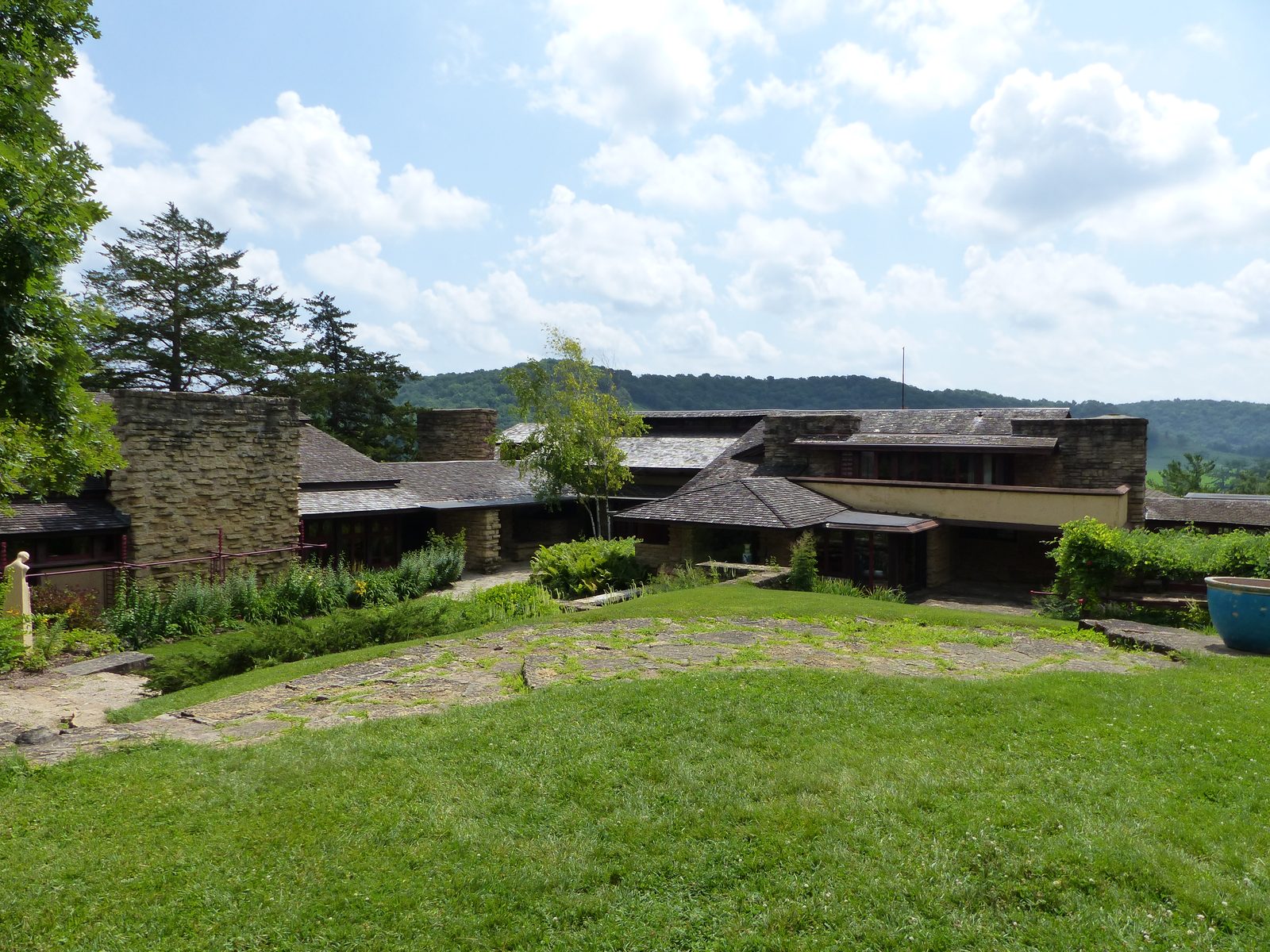
If you want to understand Frank Lloyd Wright, Taliesin is still one of the clearest places to start. As of July 15, 2026, Taliesin Preservation is running tours through the main season, with advance reservations strongly recommended because tours often sell out. That current travel hook matters, but the deeper reason Taliesin keeps drawing attention is older and more interesting: Wright never treated his Wisconsin home as a finished masterpiece. He treated it as a place that could keep becoming.
The official Taliesin site describes the property as Wright's 37,000-square-foot home, studio, school, and 800-acre estate near Spring Green, with buildings from nearly every decade of his career. That alone explains why Taliesin feels different from a single preserved house museum. It is closer to a working landscape of ideas.
Why Taliesin feels larger than one building
Taliesin means "shining brow" in Welsh, and the official site says the estate sits on the brow of a hill in Wisconsin's Driftless region. The history page adds that Wright used local limestone and Wisconsin River sand, and that the house commands the valley settled by his Welsh ancestors.
That is why the place feels so inseparable from its setting. Taliesin is not a box dropped onto scenery. The hill, courtyards, gardens, and long views are part of the architecture's logic. Even before you get to specific rooms, the site tells you that Wright wanted building and landscape to read as one composition.
Why rebuilding is part of the story, not an interruption
Taliesin also matters because its history is not smooth. The official history page says Wright moved back to the valley in 1911 after leaving his Oak Park practice. In 1914, arson destroyed the living quarters of Taliesin and seven people were murdered. Wright rebuilt. Then, in April 1925, an electrical fire in Wright's bedroom destroyed the living quarters again. He rebuilt again, producing the Taliesin III that still stands.
That cycle is more than biography. It explains why Taliesin does not feel fixed in the way many canonical houses do. The estate carries revision inside its fabric. Wright's home was a design problem he kept returning to, not a perfect answer he froze in time.
Why Taliesin became a school as much as a house
The next major shift came in 1932, when Frank and Olgivanna Lloyd Wright founded the Taliesin Fellowship. According to the official history, Hillside Home School became the Fellowship's central campus, and Wright remodeled it by adding a 5,000-square-foot drafting studio, converting the gymnasium into a theater, and adding housing for apprentices.
This is one of the most useful facts for readers who only know Taliesin from postcard views. Taliesin was not just where Wright lived. It was where people learned, drafted, performed, farmed, and tested a way of life around architecture. That is why the estate still feels more like a small world than a single domestic monument.
Why the site still has momentum in 2026
Taliesin is not only historically famous. It has a live public program right now. The tours page says the site is open daily during the main season, and the America 250 page says Taliesin Preservation will host four public lectures from August through October 2026 examining Wright's ongoing relevance to questions of housing, livable cities, sustainability, and social inequity.
That makes Taliesin unusually strong as a 2026 architecture topic. It combines broad Frank Lloyd Wright search intent, active summer visitation, and a public-program arc that points forward. At the same time, the core lesson stays evergreen: great architecture here does not come from a pristine object but from a long relationship between land, use, damage, repair, and reinvention.
Why UNESCO recognition fits the place
UNESCO inscribed The 20th-Century Architecture of Frank Lloyd Wright in 2019, and Taliesin is one of the eight components in that serial listing. UNESCO says these works demonstrate an architectural language that changed global design discourse, especially through spatial continuity, blurred transitions between inside and outside, and an integral relationship with nature.
Taliesin may be the clearest emotional version of that argument. It is where Wright's architecture looks least detachable from life around it. The estate still teaches that organic architecture was never just a style of horizontal lines. It was a way of making buildings act as part of a place.
FAQ
What is Taliesin?
Taliesin is Frank Lloyd Wright's Wisconsin home, studio, school, and estate near Spring Green.
Can you visit Taliesin in 2026?
Yes. As of July 15, 2026, Taliesin Preservation is offering seasonal tours, and it recommends advance reservations because tours often sell out.
Why is Taliesin important in Wright's career?
It was not only Wright's home. It was also a long-term laboratory where he rebuilt, refined, taught, and tested ideas across multiple decades.
Is Taliesin a UNESCO World Heritage Site?
Taliesin is one of the eight sites included in UNESCO's 2019 inscription of The 20th-Century Architecture of Frank Lloyd Wright.
Final thought: Taliesin still feels powerful because Wright never let it harden into a finished icon. He kept turning it back into a working question.
Sources Checked:
- https://www.taliesinpreservation.org/
- https://www.taliesinpreservation.org/taliesin-history
- https://www.taliesinpreservation.org/tours
- https://www.taliesinpreservation.org/america-250
- https://whc.unesco.org/en/list/1496/
- https://commons.wikimedia.org/wiki/File:Taliesin_Exterior_18.jpg
- https://commons.wikimedia.org/wiki/Special:FilePath/Taliesin_Exterior_18.jpg


Image Download Links:
- https://commons.wikimedia.org/wiki/File:Taliesin_Exterior_18.jpg
- https://commons.wikimedia.org/wiki/Special:FilePath/Taliesin_Exterior_18.jpg
- images/featured-image.jpg
Internal Link Suggestions:
- Link to the existing Rudo Studios post on Taliesin West with anchor text like
Wright's Arizona counterpart to this Wisconsin laboratory - Link to the existing Rudo Studios post on Hollyhock House with anchor text like
another Wright work where landscape and architecture were designed as one experience
Wikimedia Commons (ver arquivo original).