Tadao Ando turned concrete, glass, water, and controlled daylight into one of America's calmest museum experiences in Fort Worth.
Matheus Rudo Oliveira · 2026-11-02
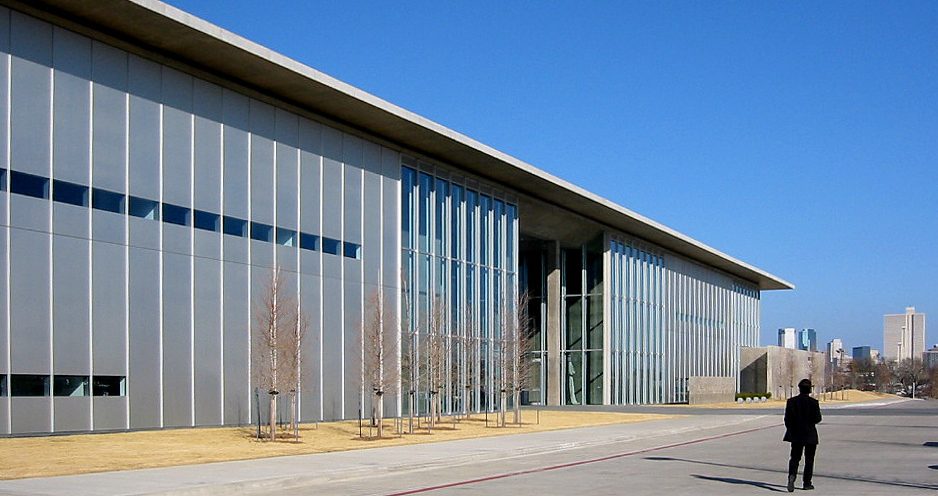
Concrete is supposed to announce its own weight, and Tadao Ando's Modern Art Museum of Fort Worth spends almost the entire visit proving that assumption incomplete. Since 2002, the museum has occupied Ando's building in Fort Worth's Cultural District, a composition of five long pavilions set on a 1.5-acre reflecting pond with 53,000 square feet of gallery space on an eleven-acre site. Those numbers sound substantial because they are substantial. What is remarkable is how little of that mass reaches the visitor as burden.
The trick is not that the concrete disappears. It is that Ando surrounds it with enough water, glass, and filtered light to change its emotional charge. The reflecting pond keeps drawing the eye away from the walls, the transparent edges prevent the galleries from feeling sealed, and the skylit interiors replace glare with a much softer kind of illumination. Even the famous Y-columns do more than hold the roof up. They make the suspended planes feel less planted than poised. That is a useful reminder that structural systems are never only technical. They can change the visitor's mood before the visitor can explain why.
This is why the building remains so persuasive more than twenty years after opening. The museum does not make concrete feel lighter by pretending concrete is delicate. It makes heaviness coexist with calm. If you are wondering who designed it, when it opened, or why it looks so serene in photographs, the answer is consistent from every angle: Ando used a hard material, but he refused to let materiality be the whole story. Water, reflection, daylight, and exact proportion do as much work here as the walls themselves.
Wikimedia Commons (ver arquivo original).