Story Mode and Free Mode offer two ways to study a building. An exercise using Azuma House shows how to bring them together.
Matheus Rudo Oliveira · 2026-11-11
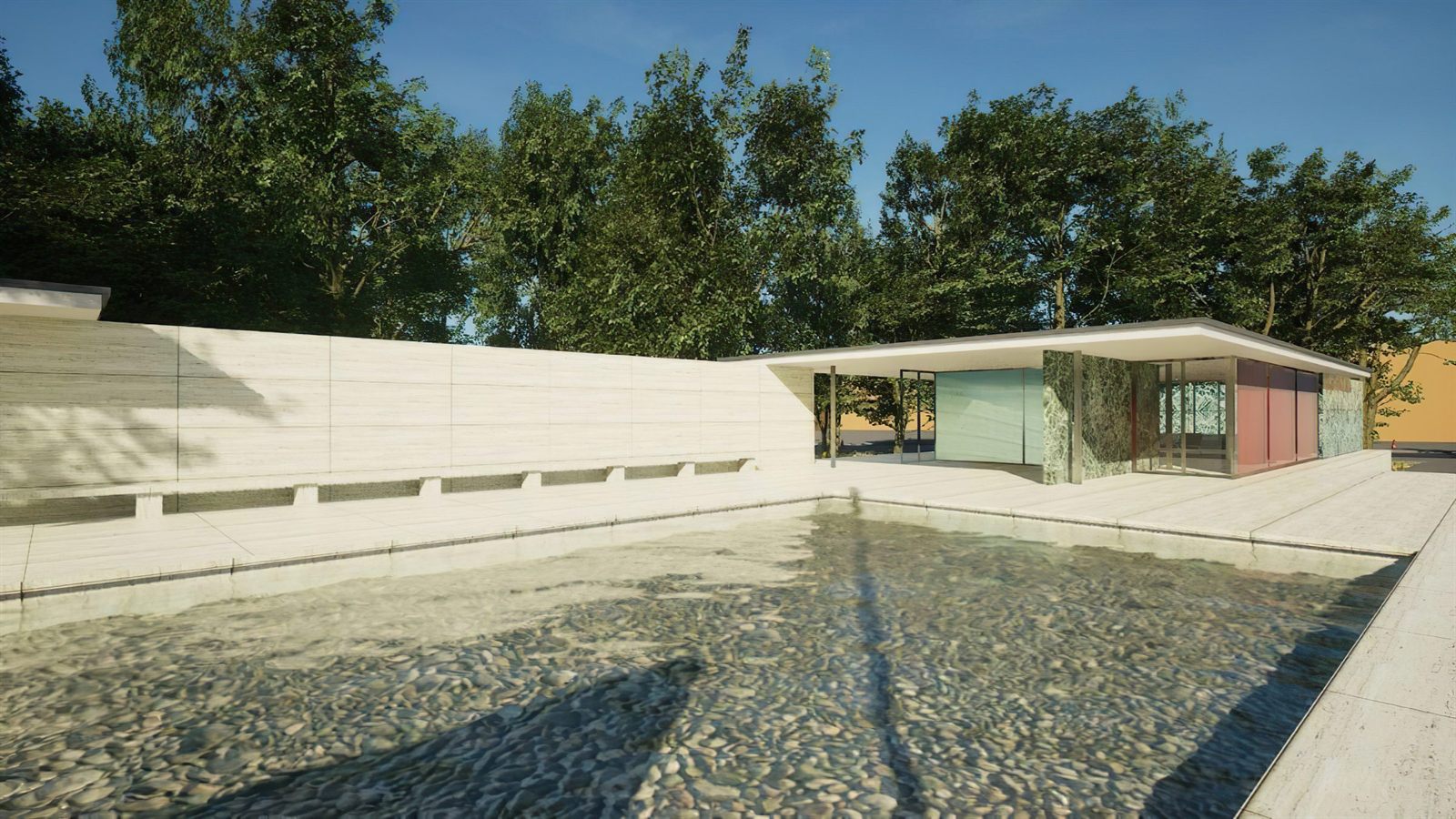
On a plan of Azuma House, you can spot the courtyard right away. Walking through the model in first person raises a different question. When do you realize you have to cross the courtyard to reach the other side? The difference between identifying a feature on a drawing and understanding what it does along the route is the starting point for this essay on Architecture Zeitgeist, an exploration game designed to support architecture education.
Students in Brazil encounter works such as Villa Savoye, Azuma House and the Barcelona Pavilion mostly through representations. Photographs and drawings make it possible to compare distant buildings, but each frames or abstracts the space in a particular way. In a navigable model, students decide where to stop, where to look and when to double back. UnB Ciência’s account of the project identifies Azuma House as the first model, developed from the building plans.
What changes when students choose their route
There are three working hypotheses. First, moving through a building helps connect scale and sequence. A narrow passage can make the next space feel more open. Second, turning, retracing your steps and trying another route can help build a mental map. You might recognize rooms individually and still misjudge where they sit in relation to one another. Third, a search task can sustain attention. It gives students a reason to examine a corner or look back, although finding an object in the game does not demonstrate an understanding of the building.
What each mode asks of players
In Story Mode, players search for notes about the building and its architect. Collecting the notes lets them progress through the guided sequence. The search gives students a shared set of references to discuss. The article on the game’s notes explains why the content is distributed throughout the model.
In Free Mode, players decide what to follow and where to linger. This invites questions a set sequence might leave aside. Where does the next room first come into view? Is the shortest route also the easiest to read? In class, students can use the same model for a guided reading, then choose a route of their own to investigate one of those questions.
An exercise using Azuma House
- Explore the house in Free Mode and note where the route takes you through the courtyard.
- Close the model and sketch the route from memory, marking what you could see before crossing.
- Check your sketch against the axonometric drawing of the house in MoMA’s catalogue, figure 5. If an opening or the sequence of rooms differs, return to the model and look for the point where your reading changed.
The sketch tells an instructor more than the time spent playing. It shows which spatial relationships students could reconstruct and where they might need another drawing, another view or an explanation. This is a suggested classroom exercise.
What the model can help assess
Digital exploration complements drawings, site visits and instruction. Perceived scale depends on the camera and movement speed. Simulated lighting, sound and textures represent selected conditions. A site visit also involves weather, changes in daylight and other people using the building.
The work presented by Maria Cláudia Candeia and Matheus Rudo Oliveira at SIGraDi 2024 describes the teaching proposal and its potential. In this essay, learning remains a hypothesis. The sketch exercise suggests how an instructor could ask a more precise question about it.
The Early Access listing shows four buildings in Story Mode and five in Free Mode, with Fallingwater still in beta. Explore Architecture Zeitgeist on Steam to explore both modes.
Further reading
- Architecture in video games (Portuguese)
- Architecture Zeitgeist updates (Portuguese)
Original essay by Matheus Rudo Oliveira. Editorial revision and English translation by Rudo Studios with AI assistance. Official game image by Rudo Studios.