The Salk Institute still feels extraordinary because Louis Kahn designed research space with the calm, light, and permanence usually reserved for monuments.
Matheus Rudo Oliveira · 2026-11-02
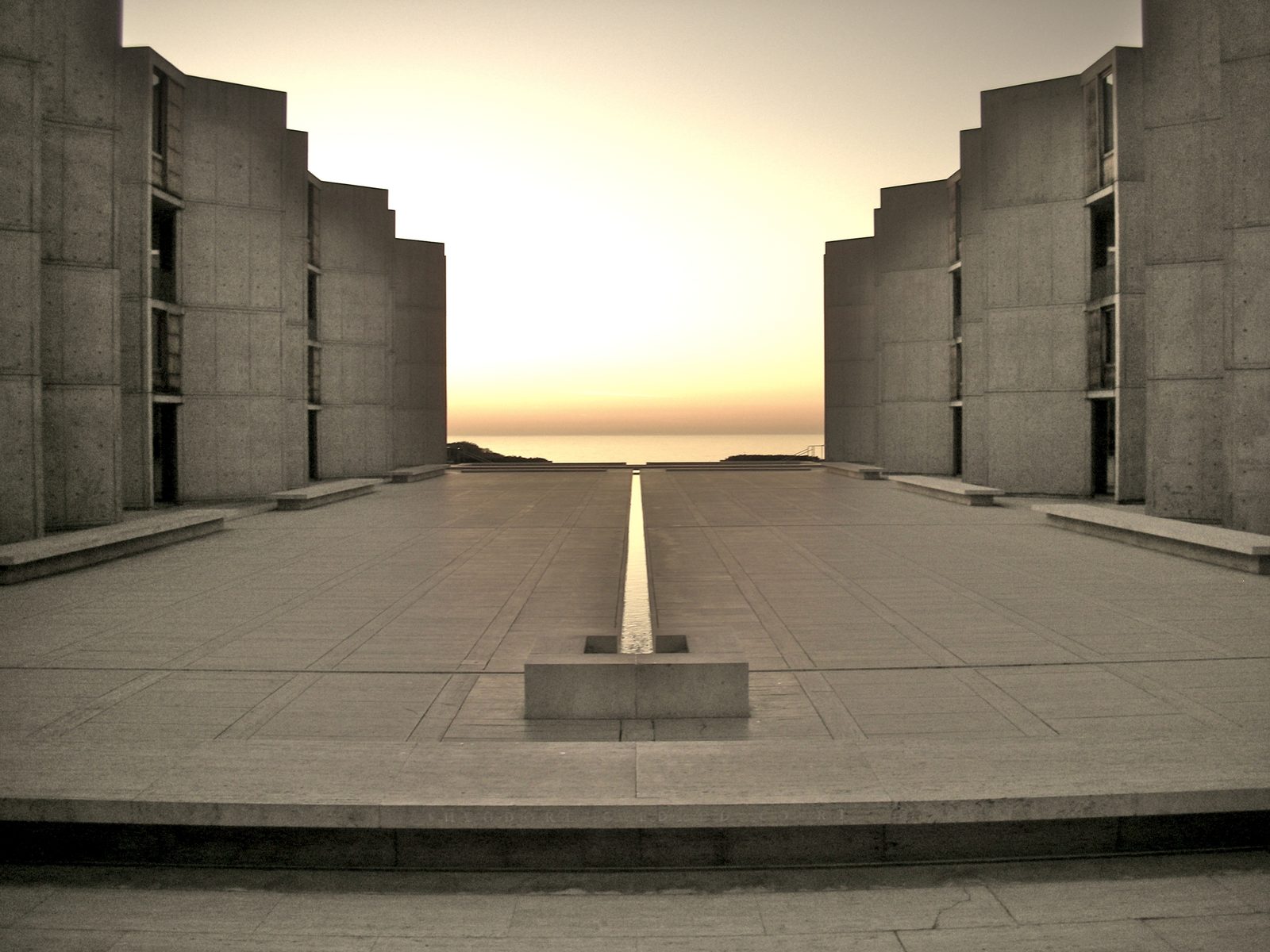
Most laboratory buildings are designed to disappear behind the work done inside them. The Salk Institute in La Jolla does the opposite. Louis Kahn gave scientific research a setting that feels deliberate, almost ceremonial, without making it precious. That is why the complex still unsettles visitors: it proves a workplace for experiments can also be one of the clearest pieces of architecture in the United States.
The building is rigorous because the science had to change
According to the institute's own architecture history, Jonas Salk wanted spaces that could adapt as research changed, along with durable materials that would need little maintenance. Kahn's answer was not a decorative shell. He organized the campus so that laboratory floors could stay flexible while mechanical and service systems were concentrated in separate service levels. On the virtual architecture tour, the institute explains that the two main blocks each hold three laboratory levels and three service floors, with office studies facing the courtyard and the Pacific beyond.
That planning decision is what makes the complex feel so calm. The practical mess is handled, but it is not allowed to dominate the experience of working there.
Why the courtyard feels larger than it is
The famous central court works because Kahn stripped it down to essentials. The Salk Institute describes it as a travertine plaza set between mirror-image laboratory blocks, with a narrow water channel running toward the ocean. In the same architecture guide, the institute notes Kahn's idea that the court should read as "a facade to the sky." You do not need the phrase to understand the effect: the space slows you down because almost nothing distracts from proportion, light, and horizon.
The materials matter just as much. The institute lists concrete, teak, leaded glass, and steel among the principal finishes, and Getty's conservation work at Salk explains how much care has gone into preserving both the teak window walls and the exposed concrete. That helps explain why the campus still feels exact rather than merely iconic. Its beauty is inseparable from maintenance, craft, and long-term stewardship.
Why June 26, 2026 is a timely moment to write about it
As of Friday, June 26, 2026, this is not a remote masterpiece you can only admire in books. The institute's visitor page says docent-led architecture tours are offered weekly on Wednesdays, Thursdays, and Fridays, while the virtual guide remains available year-round. That gives the topic a useful search hook today: readers can move directly from curiosity to an actual visit.
It also broadens the blog's recent run of domestic modernist icons. The Salk Institute is about work, infrastructure, and scientific ambition, yet it still feels emotional. That is the deeper lesson Kahn leaves here. Monumentality does not have to come from size or spectacle. Sometimes it comes from giving serious work the dignity of serious space.
FAQ
Who designed the Salk Institute?
Louis Kahn designed the Salk Institute for Biological Studies in collaboration with Jonas Salk, who selected him for the project in the 1960s.
Why is the Salk Institute important in architecture?
It is important because it joins adaptable laboratory planning, powerful material restraint, and one of the most memorable courtyards in modern architecture.
Can you visit the Salk Institute?
Yes. The official visitor page says docent-led architecture tours run weekly on Wednesdays, Thursdays, and Fridays, and the institute also offers a virtual architecture tour online.
Final thought: The Salk Institute lasts in memory because Kahn refused to treat research as something that deserved only efficiency. He gave it light, silence, and form.
Sources Checked:
- https://www.salk.edu/about/about-salk-architecture/
- https://www.salk.edu/about/visiting-salk/
- https://www.salk.edu/about/visiting-salk/virtual-architecture-tour/
- https://www.getty.edu/conservation/our_projects/built_heritage/salk/
- https://www.getty.edu/conservation/publications_resources/pdf_publications/salk_institute_report.html
- https://commons.wikimedia.org/wiki/File:Salk_Institute.jpg

Image Download Links:
- https://commons.wikimedia.org/wiki/File:Salk_Institute.jpg
- images/salk-institute.jpg
Internal Link Suggestions:
- Link to the existing Rudo Studios post on the Yale Center for British Art with anchor text like
another Louis Kahn building where quiet becomes the main event - Link to the existing Rudo Studios post on the Modern Art Museum of Fort Worth with anchor text like
a different case where concrete feels unexpectedly light
Wikimedia Commons (ver arquivo original).