Robie House is famous for its open plan, but its real magic is how Wright used brick, glass, and deep eaves to make a heavy house feel almost mobile.
Matheus Rudo Oliveira · 2026-11-02
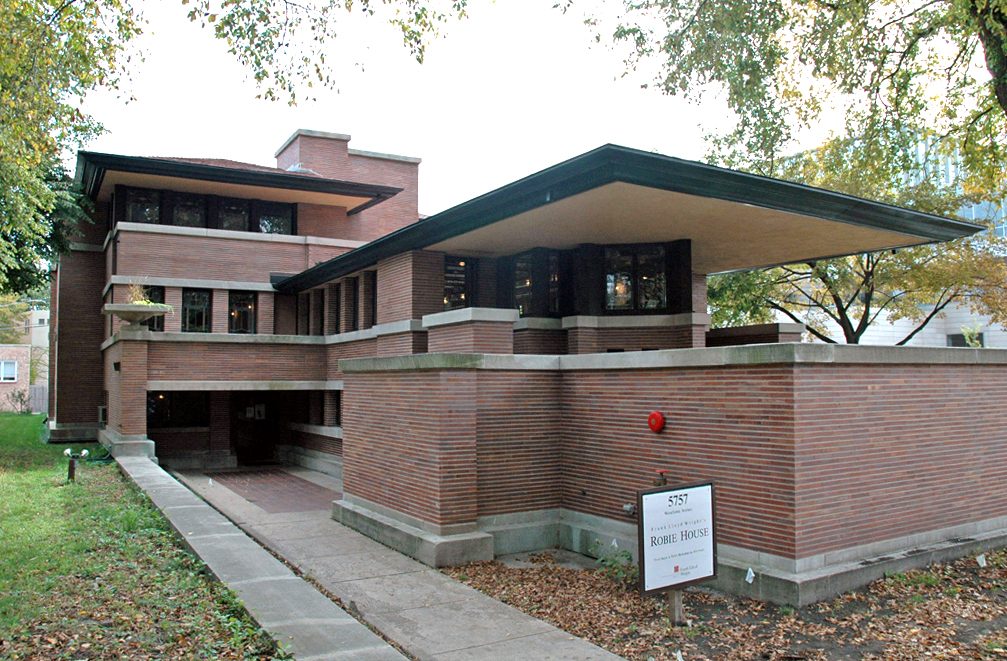
People usually remember Robie House as the long roofline house, the Prairie house, the house that opened modern domestic space. All of that is true, but it still undersells the building. What makes Robie House feel so alive is not only the open plan. It is the way Frank Lloyd Wright used brick, limestone, art glass, balconies, and cantilevered eaves to make a heavy building behave like a moving composition.
Brick is doing far more work than people think
The timing is unusually good for this angle. On July 16, 2026, the Frank Lloyd Wright Trust is hosting a talk called How Wright and Sullivan Pushed the Boundaries of Brick. That is a useful clue for reading the house itself. The Trust's Robie House page says the building's horizontality is reinforced "from the iconic roofline to the very bricks and mortar." In other words, the masonry is not background texture. It is the device that keeps your eye sliding sideways.
The Library of Congress HABS record makes the same point in different language, calling Robie House a landmark in the creation of the Prairie House, where space under wide sweeping roofs opens outward from the great hearth and where the "bold interplay of horizontal planes" established a new domestic form. That description still feels exact. At walking speed, the terraces, window bands, and low roofs keep pulling the house outward. Wright made brick act less like enclosure and more like motion.
The center is what prevents the house from drifting apart
That motion works because Robie House has a strong anchor. The Trust describes the main living and dining space as one expansive room divided only by the central chimney, with long runs of leaded glass bringing light deep into the interior. The building feels open, but not vague. The hearth mass gathers the plan while everything around it stretches toward the site.
That is why Robie House still feels more precise than many later open-plan houses. UNESCO's description of Wright's 2019 World Heritage inscription highlights the open plan and the blurring between exterior and interior as core features of his organic architecture. Robie House shows how disciplined that blur really was. The balconies extend the rooms, the glass loosens the boundary, and the deep overhangs keep the transition shaded and controlled rather than simply exposed.
Why it is worth revisiting right now
There is also a practical summer reason to care on July 3, 2026. The Trust is currently running Robie House tours from Thursday through Monday, with guided interior, in-depth, and combined indoor-outdoor options. That means the house is not just a textbook icon this month. It is an active public site in Chicago where people can test Wright's ideas in person.
That matters because Robie House is often flattened into a checklist: Prairie style, cantilevers, open plan, modernism. The richer reading is bodily. You feel the long pull of the eaves, the pause of the chimney, the steady bands of masonry, and the way the rooms seem unwilling to stop where the walls do. The house is radical not because it looks futuristic from across the street, but because its materials still choreograph experience with unusual confidence.
FAQ
What is special about Robie House?
Robie House is one of Frank Lloyd Wright's most influential residential works because it joins an open interior, dramatic cantilevers, art glass, and a brick-and-limestone composition that redefined the Prairie House.
Can you visit Robie House today?
Yes. The Frank Lloyd Wright Trust lists regular guided Robie House tours in Chicago from Thursday through Monday, with several tour formats available.
Is Robie House a UNESCO World Heritage Site?
Yes. Robie House is one of the eight components in UNESCO's The 20th-Century Architecture of Frank Lloyd Wright, inscribed in 2019.
Final thought: Robie House still feels modern because Wright did not treat brick as mere cladding. He used it to direct movement, hold space, and make a house feel both grounded and in motion at the same time.
Sources Checked:
- https://www.flwright.org/tour/robie-house
- https://www.flwright.org/explore/frederick-c-robie-house
- https://flwright.org/events-list
- https://www.loc.gov/pictures/item/il0039/
- https://whc.unesco.org/en/list/1496
- https://commons.wikimedia.org/wiki/File:Robie_House.jpg

Image Download Links:
- https://commons.wikimedia.org/wiki/File:Robie_House.jpg
- https://upload.wikimedia.org/wikipedia/commons/1/10/Robie_House.jpg
- images/featured-image.jpg

Internal Link Suggestions:
- Link to the existing Rudo Studios post on Fallingwater with anchor text like
another Wright building where materials choreograph movement as much as rooms do - Link to the existing Rudo Studios post on Charnley-Persky House with anchor text like
an earlier Chicago house that helps explain how modern domestic space was already starting to change
Wikimedia Commons (ver arquivo original).