The Glass House only makes full sense when you see its opaque twin, the Brick House, which supplies privacy, services, and the tension that makes the whole composition work.
Matheus Rudo Oliveira · 2026-11-02
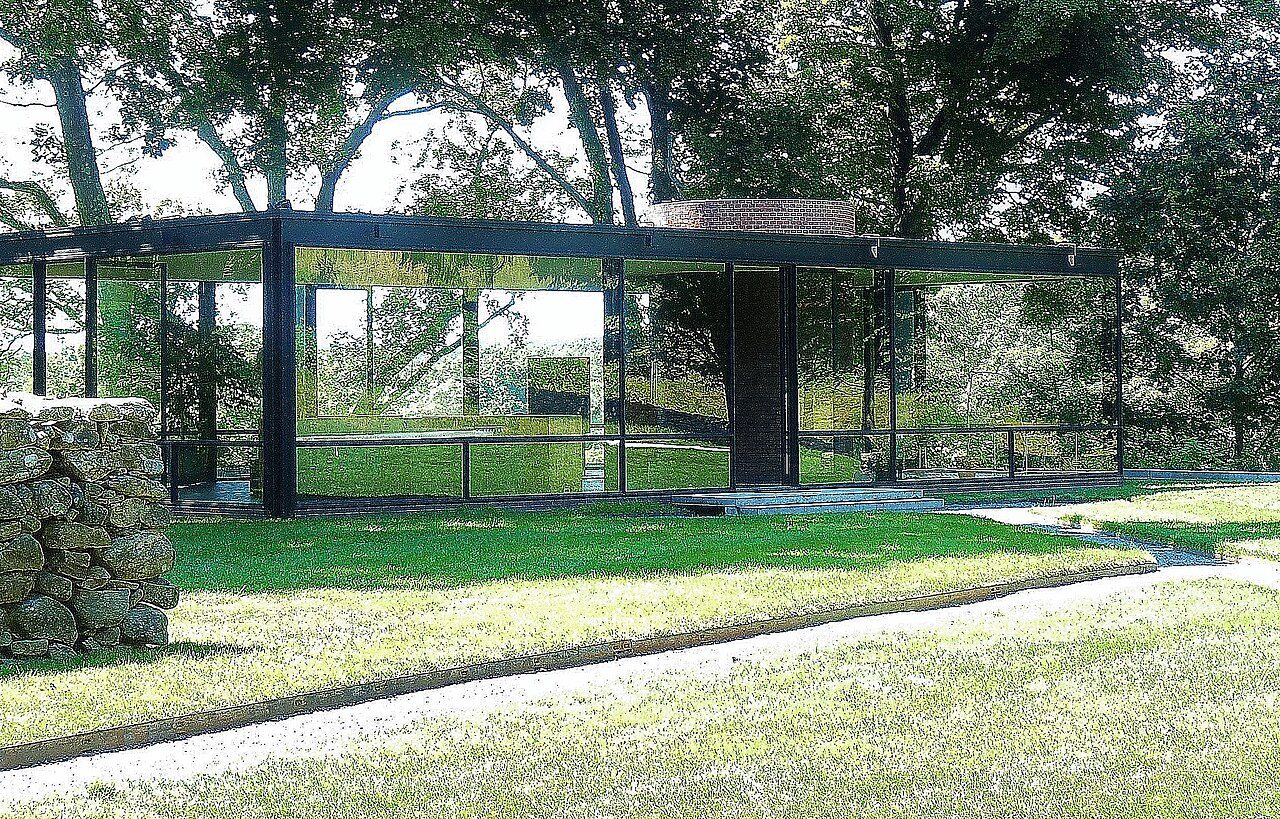
Philip Johnson's Glass House is so familiar as an image that many people forget it was never intended to stand alone. The official Glass House history is unusually clear on this point: Johnson conceived the Glass House as half a composition completed by the Brick House across the court. Once you know that, the project becomes more intelligent immediately. Transparency stops being the whole message and starts becoming one side of an argument. The glass pavilion offers exposure, view, and formal reduction; the brick companion supplies privacy, services, and a necessary kind of resistance.
That resistance is what makes the site architectural rather than merely photogenic. The Brick House contains support systems for both buildings, which is a practical fact but also a conceptual one. One of the most transparent houses in modern architecture depends on an opaque structure to function. The court between them matters just as much. It creates distance, turns walking into part of the composition, and prevents the Glass House from collapsing into a single visual stunt. Even Johnson's supposedly open interior was more controlled than the cliche suggests. He referred to distinct rooms within the glass rectangle, which tells you that radical openness here was carefully managed, not naively total.
The later history strengthens the point. The restored Brick House reopened in 2024 after a fifteen-year closure caused by water infiltration, and that restoration made the pair easier to understand again as a single composition. So if you are asking when the house was built, why the Brick House matters, or what still makes the site visitable beyond the postcard image, the answer is the same: Glass House architecture only works because its opposite exists nearby. Johnson's famous transparency is persuasive precisely because it is never left unsupported.
Wikimedia Commons (ver arquivo original).