Berlin's Neue Nationalgalerie still feels startlingly current because Mies van der Rohe designed a museum that changes with light, sky, and movement.
Matheus Rudo Oliveira · 2026-11-02
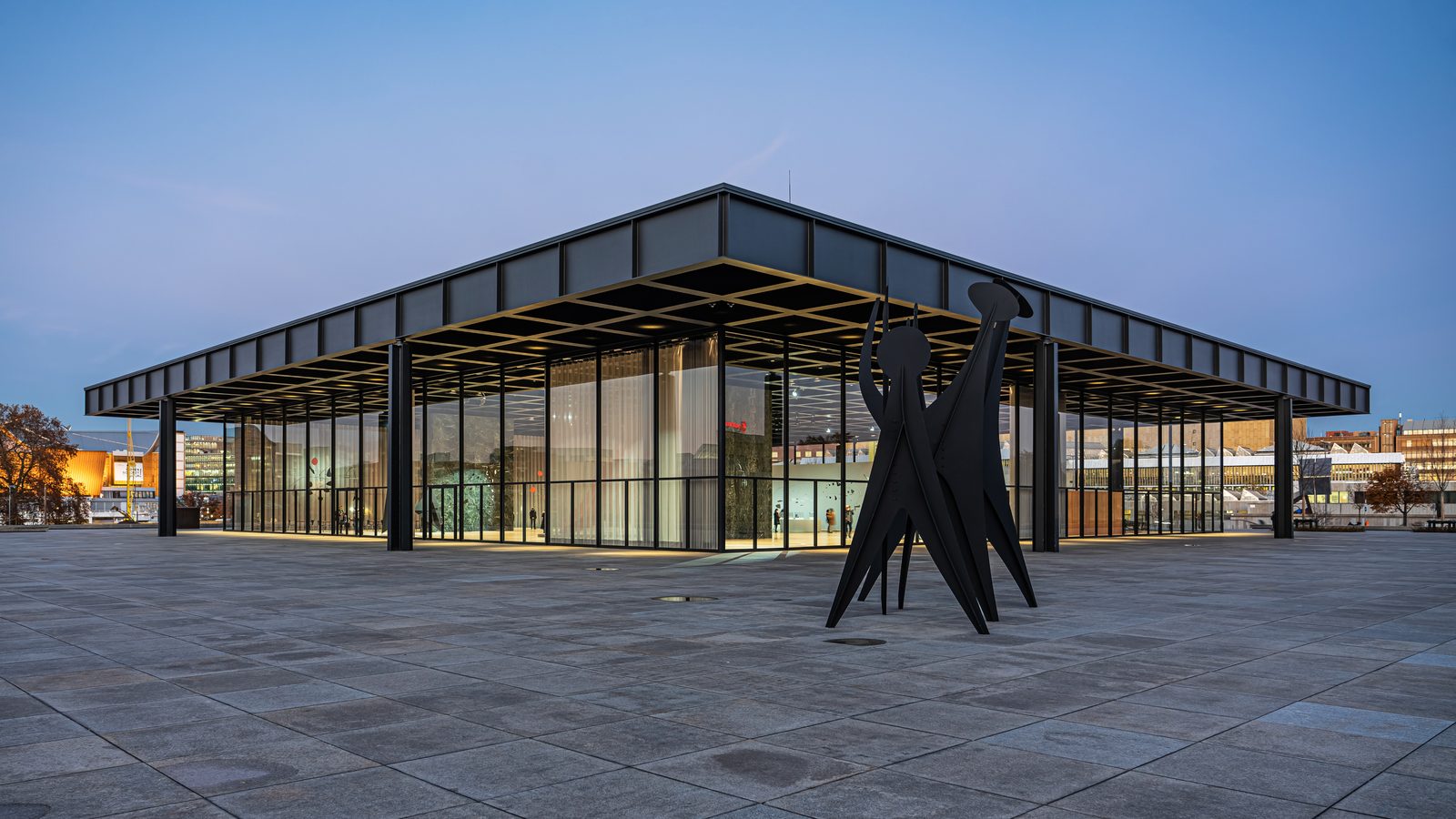
If many modernist museums look better in theory than in person, the Neue Nationalgalerie in Berlin is the exception that keeps proving the theory wrong. Opened in 1968 and designed by Ludwig Mies van der Rohe, it still feels unusually alive because the building never behaves like a sealed container. It behaves more like a frame for light, weather, movement, and public life.
That makes it a strong architecture story on July 13, 2026. The museum is currently running Fujiko Nakaya's fog sculpture through October 25, 2026, the official site lists a Mies van der Rohe: Less is more public tour on July 18, 2026, and an Understanding Architecture tour on July 26, 2026. That is a rare overlap of famous-architect search intent, a real travel hook, and an evergreen design lesson.
Why the building matters beyond minimalism
The official museum profile calls the Neue Nationalgalerie Mies van der Rohe's last major project and says his long effort to create pillar-free, open spaces culminated in its glass hall. That description matters because the building is often reduced to a slogan about "less is more." In reality, it is less about emptiness than about control. Mies stripped the form down so that proportion, structure, and view would do the emotional work.
The refurbishment page adds another useful fact: the Berlin Senate commissioned the museum in 1962, it was built between 1965 and 1968, and it is the only building Mies erected in Germany after the Second World War. That helps explain why the museum feels so concentrated. It is not a sketch for later work. It is a late statement.
Why it feels more like weather than a room
The clearest current proof comes from the Fujiko Nakaya installation. The official exhibition page says the fog sculpture fills the sculpture garden and that the museum's 90-meter-long glass facade gives visitors a dramatic view of shifting fog formations from inside. That detail explains the building better than many formal analyses do. The museum is powerful because its glass hall does not just show art. It shows conditions.
From some moments the building feels sharp and absolute. A few minutes later, changing light, reflections, or fog make it feel nearly immaterial. Mies made a museum where atmosphere is not decoration added afterward. Atmosphere is part of the architecture.
Why the sculpture garden completes the idea
The same exhibition page notes that visitors can move directly from the collection area into the garden and into the fog itself. That matters because the Neue Nationalgalerie is not only a famous roof over a glass box. It is a sequence: podium, hall, stair, lower galleries, and open-air garden. The garden keeps the building from becoming too abstract. It gives the museum weight, distance, and a changing edge against the city.
This is also why current programming fits the architecture so well. The museum is not treating the building as a neutral backdrop. It is using the site the way Mies designed it: as a place where art, people, and the surrounding environment stay in conversation.
Why it still feels current in 2026
The official profile says the museum was extensively refurbished and modernized from 2015 to 2021 after nearly fifty years of use. That is important because the building is not surviving on reputation alone. It is still functioning as an active public place with live exhibitions, tours, and repeat visits. The current exhibitions page shows a busy 2026 season, including Brancusi through August 9, 2026 and Ruin and Rush. Berlin 1910-1930 through January 3, 2027.
For readers searching which Mies buildings are still worth traveling for, that makes the answer easy. The Neue Nationalgalerie is not memorable just because it is canonical. It is memorable because it can still absorb new art, new weather, and new bodies without losing its calm.
FAQ
What is the Neue Nationalgalerie?
The Neue Nationalgalerie is a museum for 20th-century art in Berlin designed by Ludwig Mies van der Rohe and opened in 1968.
Why is the Neue Nationalgalerie famous?
It is famous for its steel roof, pillar-free glass hall, and late-career Mies design that turns structure, proportion, and atmosphere into the main experience.
Can you visit the Neue Nationalgalerie in July 2026?
Yes. As of July 13, 2026, the official museum site lists current exhibitions plus public architecture-related tours on July 18 and July 26, 2026.
What makes the building feel different from other modernist museums?
Its power comes from how the glass hall, podium, and sculpture garden respond to changing light, reflections, and weather rather than acting like a fixed object.
Final thought: The Neue Nationalgalerie still feels radical because Mies reduced the building so far that the sky, the city, and the visitor had to finish it.
Sources Checked:
- https://www.smb.museum/en/museums-institutions/neue-nationalgalerie/about-us/profile/
- https://www.smb.museum/en/museums-institutions/neue-nationalgalerie/about-us/refurbishment/
- https://www.smb.museum/en/exhibitions/detail/fujiko-nakaya-fog-sculpture-in-the-sculpture-garden-of-the-neue-nationalgalerie/
- https://www.smb.museum/en/museums-institutions/neue-nationalgalerie/education-outreach/adults/
- https://www.smb.museum/en/museums-institutions/neue-nationalgalerie/exhibitions/current/
- https://commons.wikimedia.org/wiki/File:Berlin_Neue_Nationalgalerie_asv2021-11_img1.jpg
- https://commons.wikimedia.org/wiki/Special:FilePath/Berlin_Neue_Nationalgalerie_asv2021-11_img1.jpg


Image Download Links:
- https://commons.wikimedia.org/wiki/File:Berlin_Neue_Nationalgalerie_asv2021-11_img1.jpg
- https://commons.wikimedia.org/wiki/Special:FilePath/Berlin_Neue_Nationalgalerie_asv2021-11_img1.jpg
- images/featured-image.jpg
Internal Link Suggestions:
- Link to the existing Rudo Studios post on the Barcelona Pavilion with anchor text like
another Mies project where almost nothing still feels monumental - Link to the existing Rudo Studios post on S. R. Crown Hall with anchor text like
a different Mies building where one open room does nearly everything
Wikimedia Commons (ver arquivo original).