The Milwaukee Art Museum is famous for its wings, but the deeper architectural lesson is how Santiago Calatrava turned the whole approach into a public performance.
Matheus Rudo Oliveira · 2026-11-02
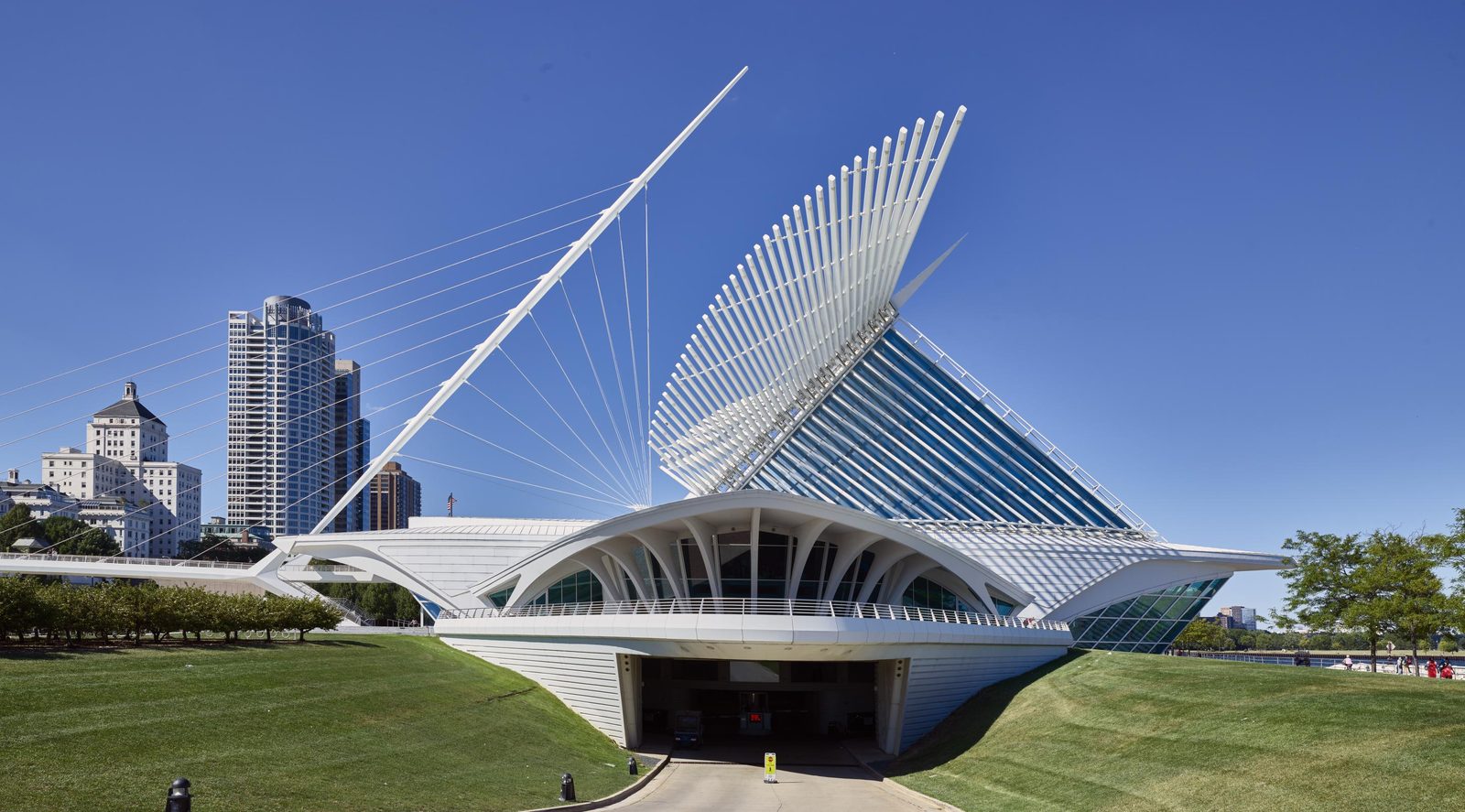
Most people remember the Milwaukee Art Museum because of the wings. That is fair, but incomplete. The more interesting move happens before you look up. Santiago Calatrava made the approach feel ceremonial, so the building starts out in the city, across a bridge, under a mast, and into a hall that feels part station, part cathedral, part ship. The arrival sequence becomes as memorable as the galleries.
It is not one icon but a layered civic composition
The museum's official architecture overview makes an important point that photos often flatten: this is not a standalone object but a campus of three buildings by Eero Saarinen, David Kahler, and Santiago Calatrava. Saarinen's War Memorial Center opened in 1957, Kahler added gallery space in 1975, and Calatrava's Quadracci Pavilion arrived in 2001. The museum history page adds that the pavilion did more than expand the program. It gave Milwaukee a new international icon.
That matters because the Quadracci Pavilion works best when you read it against what came before. Calatrava's own project overview describes the earlier Saarinen-Kahler ensemble as massive and concrete, then explains that he proposed a pavilion on the axis of Wisconsin Avenue as an independent white steel-and-concrete form. The drama is in the contrast: a heavy civic complex meets a lighter, more kinetic public front.
The real architectural trick is the route in
On the Calatrava project page, the architect explains that pedestrians can cross Lincoln Memorial Drive on the cable-stayed Reiman Bridge and continue directly into the pavilion. That sounds practical, but it is the key to the composition. The Quadracci Pavilion page describes Windhover Hall as a 90-foot-high reception space with flying buttresses, pointed arches, ribbed vaults, and a ship-like chancel aimed toward Lake Michigan. The building is staging your movement, not just housing it.
This is why the pavilion still feels persuasive. Many museum additions try to signal importance with sheer scale. Here, the better effect comes from choreography. You cross a bridge, rise toward the mast, enter a vast white volume, and only then understand how the lake, skyline, and museum are tied together. Calatrava said the design responds to "the culture of the lake," including sailboats, weather, motion, and change. That is more precise than calling it merely birdlike.
The wings matter, but not for the usual reason
The museum notes that the Burke Brise Soleil has a 217-foot wingspan, and the detailed pavilion page adds that it is made of 72 steel fins, takes 3.5 minutes to open or close, and shuts automatically when winds exceed 23 miles per hour for more than three seconds. Those details explain why the famous wings do not feel like decoration. They are a working sunscreen, a weather instrument, and a public signal at once.
That combination keeps the building from slipping into empty spectacle. Calatrava wrote that the crowning element is formal, functional, symbolic, and iconic at the same time. The wings are memorable because they do something, not just because they photograph well.
Why this is a strong architecture stop right now
The timing is unusually clean. As of Sunday, July 5, 2026, the museum is open from 10 A.M. to 5 P.M., and it is hosting a docent-led architecture and collection tour from 2:00 to 3:00 P.M. in Windhover Hall. That gives the building a same-day public hook without turning the post into disposable event copy. Even after today's tour ends, the larger point remains evergreen: circulation, climate, engineering, and civic theater all reinforce each other here.
FAQ
Why is the Milwaukee Art Museum famous?
It is famous for the Quadracci Pavilion and its moveable Burke Brise Soleil, but also because one waterfront campus combines major works by Saarinen, Kahler, and Calatrava.
Who designed the Milwaukee Art Museum?
The campus includes Saarinen's 1957 War Memorial Center, Kahler's 1975 addition, and Calatrava's 2001 Quadracci Pavilion.
Can you tour the architecture?
Yes. The museum regularly highlights the building in its programming, and on July 5, 2026 it is listing a docent-led architecture and collection tour in Windhover Hall.
Final thought: The Milwaukee Art Museum is at its best when you stop thinking of it as a winged object and start reading it as a sequence. Calatrava's real accomplishment was making arrival itself feel like part of the art.
Sources Checked:
- https://mam.org/info/architecture/
- https://mam.org/info/architecture/quadracci-pavilion/
- https://mam.org/info/history/
- https://mam.org/events/event/architecture-and-highlights/2026-07-05/
- https://calatrava.com/projects/milwaukee-art-museum.html
- https://commons.wikimedia.org/wiki/File:Milwaukee_Art_Museum_Quadracci_Pavilion_2016.jpg

Image Download Links:
- https://commons.wikimedia.org/wiki/File:Milwaukee_Art_Museum_Quadracci_Pavilion_2016.jpg
- https://upload.wikimedia.org/wikipedia/commons/7/71/Milwaukee_Art_Museum_Quadracci_Pavilion_2016.jpg
- images/featured-image.jpg

Internal Link Suggestions:
- Link to the existing Rudo Studios post on the Carpenter Center with anchor text like
another modern building where movement through the structure is the main architectural idea - Link to the existing Rudo Studios post on Eero Saarinen's TWA Flight Center with anchor text like
another famous project where arrival was designed as a full emotional experience
Wikimedia Commons (ver arquivo original).