Mies van der Rohe's Farnsworth House still feels radical because its glass walls, raised platform, and disciplined plan turn a weekend retreat into a lasting argument about how little architecture really needs.
Matheus Rudo Oliveira · 2026-11-01
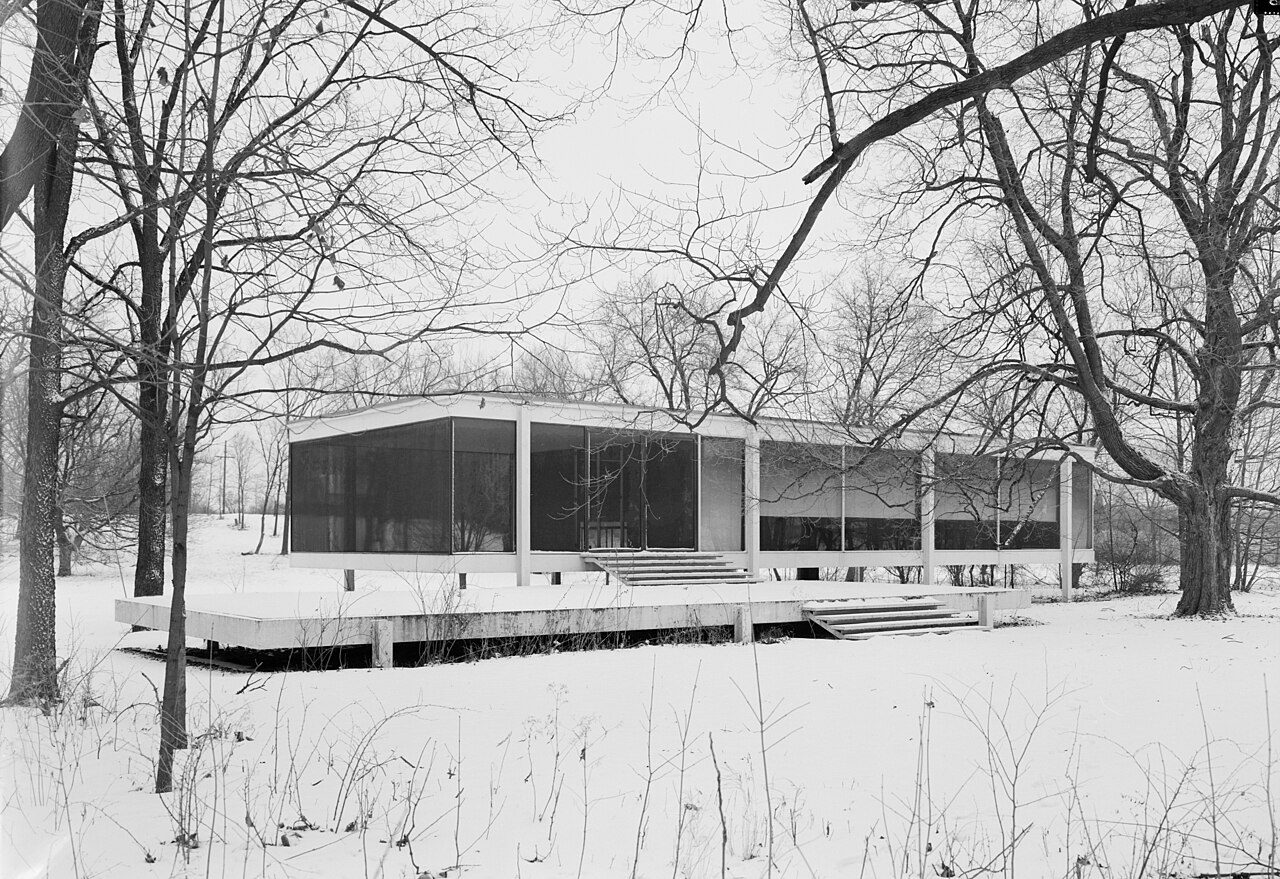
Farnsworth House is so famous as a glass box in a landscape that it can start to sound simpler than it really is. The simplification misses the reason the building still unsettles people. Designed for Dr. Edith Farnsworth and completed in 1951 after construction began in September 1949, the house reduces domestic life to a steel frame, broad horizontal planes, glass walls, and a compact service core. That reduction still feels radical because it is not presented as an aesthetic mood board. It is presented as a serious proposition about how little a house might need if proportion, structure, and landscape are handled with enough precision.
The house also becomes more interesting the closer you get to the site conditions. Ashley Wilson's National Park Service preservation account explains that Mies set the finish floor about five feet above grade, roughly one foot above the highest recorded flood level known at the time, and intended the lower terrace to flood occasionally while keeping the main interior above water. That is one of the most revealing facts about the project because it shows the floodplain was never an accidental backdrop. Risk was already part of the architectural logic. What history changed was the scale of that risk, which is why repeated flooding and later stewardship have become inseparable from the house's meaning.
Then there is the human conflict, which keeps the building from ever becoming too pure a myth. The National Historic Landmark nomination records that Mies sued for unpaid fees and Edith Farnsworth countersued over costs and construction problems, leaving one of modernism's canonical houses permanently tied to a dispute about whether its rigor was livable. That tension is not a side note. It is one of the reasons the house remains alive as an argument. The current 75th-anniversary programming at the official Edith Farnsworth House site only sharpens that relevance. If you are asking where the house is, why it matters, or whether it can still be visited, the answer comes with the same complication that has always made it compelling: Farnsworth House is beautiful, influential, vulnerable, and debatable all at once.
Wikimedia Commons (ver arquivo original).