For International Day for Monuments and Sites, explore why Le Corbusier's Capitol Complex in Chandigarh became a UNESCO World Heritage landmark and what its concrete, shade, symbolism, and civic scale still teach architects today.
Matheus Rudo Oliveira · 2026-11-01
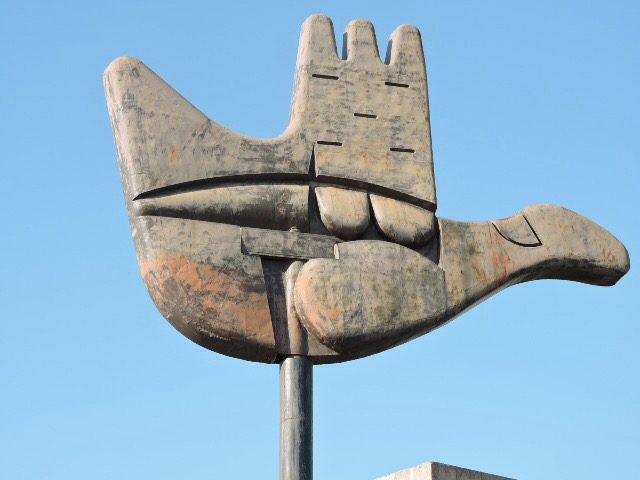
Chandigarh's Capitol Complex is one of modern architecture's clearest tests: can concrete, geometry, shade, and civic symbolism create a public landscape that still matters decades later?
Designed by Le Corbusier in the early years of post-independence India, the complex is not an ancient ruin or a frozen monument. It remains tied to government, public memory, conservation, and debate.
Why Chandigarh Matters
After India's independence in 1947 and the partition of Punjab, Chandigarh was planned as a new capital. At the northern end of the city, backed by the Shivalik Hills, Le Corbusier placed the Capitol Complex as the symbolic "head" of the plan.
The precinct includes major government buildings such as the Palace of Assembly, the Secretariat, and the High Court, along with monuments including the Open Hand and the Tower of Shadows.
This gave Le Corbusier's modernism an unusually public scale. His ideas were no longer limited to houses, villas, or theory. They became part of a new civic identity.
Concrete, Climate, and Power
The Capitol Complex is often remembered for its sculptural concrete, but its lessons are not only visual. The buildings use deep shade, large overhangs, brise-soleil, monumental ramps, and open spaces to negotiate heat, sun, ceremony, and everyday movement.
That is what makes the complex useful today. It shows that climate response and symbolism do not have to be separate. A wall can shade. A roof can become a civic sign. A monument can organize both meaning and movement.
Why It Still Teaches
In 2016, UNESCO inscribed the Capitol Complex as part of the transnational World Heritage property for Le Corbusier's work. That recognition matters because it frames Chandigarh as modern heritage, not just modern design.
The complex also reminds architects that public buildings are never neutral. They communicate power, aspiration, access, and control. Chandigarh's concrete is beautiful, but it is also political.
Final Thought
Le Corbusier's Chandigarh still matters because it asks architecture to do more than look modern. It asks buildings to carry climate, government, symbolism, and public life at the same time.
Creative Commons Attribution-ShareAlike 4.0 International (CC BY-SA 4.0). Attribution: Nicholas.iyadurai / Wikimedia Commons. Original file: Palace of the Assembly - Chandigarh - Le Corbusier.jpg
