Frank Lloyd Wright turned Johnson Wax Headquarters into more than an office. He made work feel staged, communal, and unexpectedly dignified.
Matheus Rudo Oliveira · 2026-11-02
Johnson Wax Headquarters: Why Wright Made Work Feel Ceremonial
Most famous Frank Lloyd Wright buildings promise a dramatic home, a desert camp, or a museum-like pilgrimage. Johnson Wax Headquarters offers something stranger: an office building that tries to make ordinary work feel important.
That is what still makes the complex in Racine, Wisconsin, so compelling. When Wright designed the SC Johnson Administration Building in 1936 and it opened in 1939, he did not treat the workplace as a neutral container. He designed it as a shared interior with atmosphere, hierarchy, ritual, and spectacle. The later Research Tower, built from 1947 to 1950, extended that ambition into a vertical laboratory. Together, the two buildings show that Wright was not just designing efficient space. He was redesigning how a company imagined itself.
The Real Surprise Is That This Was a Workplace
The easiest way to misunderstand Johnson Wax Headquarters is to file it under "famous modernist landmark" and stop there. The better question is simpler: why would a company ask Frank Lloyd Wright to make office work feel almost civic?
According to SC Johnson's own history, third-generation leader H.F. Johnson, Jr. abandoned earlier office plans in 1936 to pursue something more modern with Wright. The decision was a risk, but it explains the building's lasting charge. Johnson did not want a routine headquarters. He wanted a building that announced confidence.
That ambition still reads clearly in the Great Workroom. Instead of corridors and conventional office compartments, Wright created a large communal interior supported by his dendriform columns, wrapped with Pyrex glass tubing, and arranged to feel ordered rather than bureaucratic. The result was not cozy, but it was memorable. Work happened in public, under a canopy of structure and light.
Why the Great Workroom Still Feels Like a Ceremony
SC Johnson describes the Great Workroom as a half-acre interior forest of columns, and that is the right way to think about it. The room does not feel like a floor plate filled with desks. It feels like a collective chamber.
Wright compared the building's ambition to a cathedral-like place for work, and that comparison explains the effect better than any style label. The columns are central to it. At the base they are only nine inches in diameter, then expand to tops 18.5 feet across. The scale shift is so dramatic that the room feels both delicate and monumental at once.
This is the key to the building's curiosity hook. The Johnson Wax Headquarters is not remarkable because it is luxurious in the usual corporate sense. It is remarkable because it treats labor as something worth staging.
The Columns Were Not Just Beautiful. They Had to Prove Themselves
One of the best-documented stories about the building is also one of the most revealing. The Wisconsin authorities were skeptical of Wright's column design, and the permit was delayed until a sample column could be tested. The National Park Service summary of Frank Lloyd Wright landmarks notes that Wright subjected the column to 60 tons of dead weight even though it was expected to carry only 2 to 12 tons. The test helped secure approval in 1937.
That episode matters for more than drama. It shows how much of Johnson Wax depends on Wright turning structural doubt into architectural theater. The columns are not decorative extras added after the engineering was solved. They are the engineering argument made visible.
Why the Building Feels So Different From Other Modern Offices
The Frank Lloyd Wright Foundation places Johnson Wax in a lineage with Wright's earlier Larkin Building, another attempt to shape work through a large communal room rather than through a pile of separate offices. That comparison helps explain why Johnson Wax still feels unusual today.
Many later offices borrowed the open-plan idea without borrowing Wright's sense of occasion. Johnson Wax does not simply remove walls. It gives the shared room spatial dignity. The light is filtered through glass tubing rather than standard windows. The furniture was designed for the building. The elevators feel theatrical. Even the brickwork was customized, with nearly 200 special brick shapes created to fit the design, according to SC Johnson.
Minimal offices often try to disappear. Johnson Wax does the opposite. It tells workers, visitors, and clients that this place has been composed.
The Research Tower Took the Same Ambition Upward
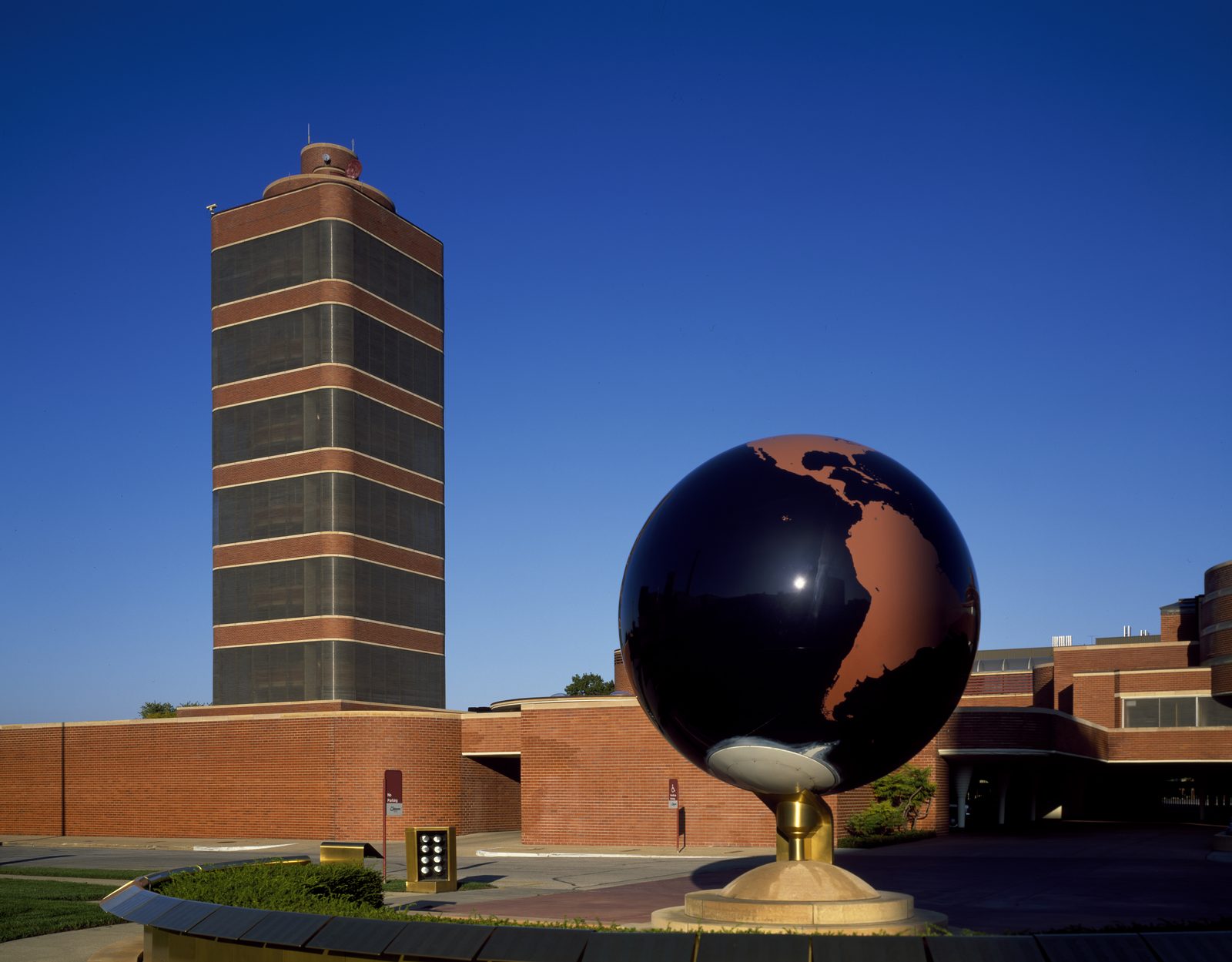
The Research Tower deserves more attention than it usually gets. SC Johnson's history of the tower explains that it has 15 floors supported by a central core that extends 54 feet into the ground. Its alternating square floors and round mezzanine levels made the laboratory feel experimental before a single product was tested there.
Wright called it a "helio-lab," emphasizing its relation to sunlight. That term sounds romantic, but the architecture supports it. The tower rises more than 150 feet while reading as improbably slender at the base. Like the Great Workroom, it converts technical problem-solving into a visual idea people can remember.
If the Administration Building made office work feel ceremonial, the Research Tower made scientific work feel aspirational.
Why Johnson Wax Still Matters in 2026
Johnson Wax Headquarters remains unusually alive as architecture because it still carries its original function and public visibility. The National Park Service describes the complex as a classic of modern office design that continues to serve its original purpose and still contains original furnishings designed by Wright. That continuity matters. Many canonical modern buildings are now frozen as museum objects. Johnson Wax is still legible as an active workplace.
It is also still visitable. As of Sunday, July 26, 2026, SC Johnson's tours page says tours of the Racine campus are free and include the Administration Building and Research Tower. For architecture readers, that makes the building more than a historical reference. It is a serious travel-worthy stop.
What Architects and Clients Can Learn From It
1. Office space can express values, not just operations
Johnson Wax works because the client and architect agreed that a headquarters could communicate ambition in spatial form.
2. Structure can become the story
The famous columns are unforgettable because they are not applied symbolism. They are the building's central technical and visual fact.
3. Open plan only becomes powerful when it has character
Wright did not make a generic open office. He gave the shared room scale, light, rhythm, and ceremony.
FAQ
What is the Johnson Wax Headquarters?
Johnson Wax Headquarters is the SC Johnson corporate campus in Racine, Wisconsin, best known for Frank Lloyd Wright's Administration Building and Research Tower.
When was Johnson Wax Headquarters built?
The Administration Building was commissioned in 1936 and opened in 1939. The Research Tower was constructed between 1947 and 1950.
Why is Johnson Wax Headquarters important?
It is one of the clearest examples of Wright turning an office building into a memorable architectural experience, and the National Park Service describes it as a classic of modern office design.
Can you visit Johnson Wax Headquarters today?
Yes. As of Sunday, July 26, 2026, SC Johnson says its Racine campus tours are free and open to the public with advance reservation.
Final Thought
Johnson Wax Headquarters is easy to admire for its columns, glass tubes, and famous name. Its deeper lesson is harder and more useful: Wright believed work deserved architecture with dignity, not just efficiency. That is why the building still feels less like an office block and more like a place where daily routine was meant to matter.
Internal Link Suggestions
- Why Fallingwater Still Feels Radical 90 Years Later
- Taliesin: Why Frank Lloyd Wright Made a Home That Never Stopped Becoming
- S R Crown Hall: Why Mies Made One Room Do Almost Everything
Sources Checked
- https://scjohnson.com/en/news-stories/blog/administration-building
- https://scjohnson.com/en/news-stories/blog/research-tower
- https://scjohnson.com/en/community/experience-scj/tours
- https://scjohnson.com/en/news-stories/official-communications/sc-johnson-architecture
- https://franklloydwright.org/frank-lloyd-wrights-larkin-and-johnson-wax-workspaces/
- https://www.nps.gov/subjects/nationalhistoriclandmarks/upload/Wright-Rep-2015-update.pdf
- https://commons.wikimedia.org/wiki/File:Building,_globe,_and_grounds_of_the_S.C._Johnson_and_son_headquarters_building,_designed_by_Frank_Lloyd_Wright,_Racine,_Wisconsin_LCCN2011634906.jpg

Image Download Links
- https://commons.wikimedia.org/wiki/File:Building,_globe,_and_grounds_of_the_S.C._Johnson_and_son_headquarters_building,_designed_by_Frank_Lloyd_Wright,_Racine,_Wisconsin_LCCN2011634906.jpg
- https://commons.wikimedia.org/wiki/Special:FilePath/Building,_globe,_and_grounds_of_the_S.C._Johnson_and_son_headquarters_building,_designed_by_Frank_Lloyd_Wright,_Racine,_Wisconsin_LCCN2011634906.jpg

Wikimedia Commons (ver arquivo original).