Martin House is not just a Prairie masterpiece. Its current restoration story shows why Wright's windows, furniture, and lost objects are part of the architecture itself.
Matheus Rudo Oliveira · 2026-11-02
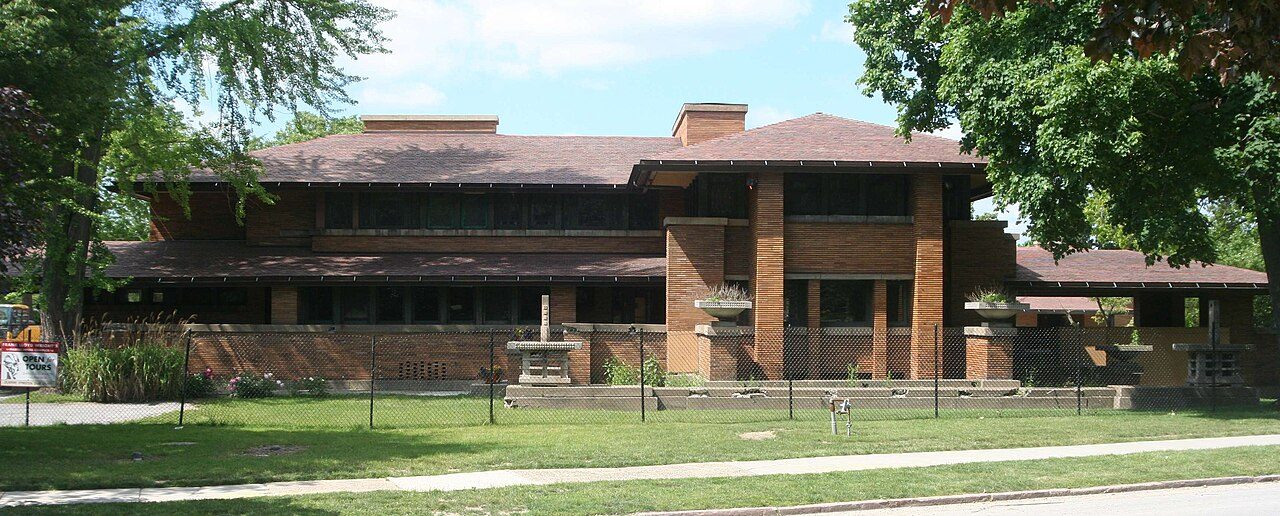
Most people first meet Frank Lloyd Wright's Martin House as a Prairie masterpiece: long brick lines, broad sheltering roofs, the famous pergola, and one of the great client-architect partnerships of the early twentieth century. That description is true, but in June 2026 it is not the most interesting one. The sharper story comes from Martin House's current exhibition, Collecting Ourselves, which runs from March 27 through September 7, 2026 and focuses on the objects that were lost, dispersed, found, restored, and returned along with the building itself. That angle matters because it reveals something readers do not always expect from Wright: at Martin House, the architecture does not stop at the walls.
Built between 1903 and 1905 for Buffalo executive Darwin D. Martin and his family, the house is still described by the official site as one of the great achievements of Wright's career. Wright called it a “domestic symphony”, and that phrase is more useful than it first sounds. A symphony depends on relationships, timing, and parts working together. Martin House was conceived as a total environment: the main residence, the Barton House, the pergola and conservatory, the decorative program, the furnishings, the landscape, and above all the art glass. Once you look at it that way, the current exhibition stops feeling like a side story and starts reading as a key to the whole estate.
Why the glass and furnishings are part of the building
The official exhibition page makes the argument plainly. Structural reconstruction usually gets the prestige in house-museum restoration, while the slower work of recovering furniture, art glass, artwork, and ephemera gets treated as secondary. At Martin House, however, collections are described as critical to the restoration effort because many of these pieces were designed or selected specifically for this house. Recovering them is not decorative cleanup. It is architectural repair.
The art glass makes that especially clear. According to The Martin House Art Glass Collection, Wright created nearly 400 examples of decorative glass at the complex in sixteen primary patterns, fabricated by the Linden Glass Company of Chicago. That single fact changes how the house reads. Martin House is not simply a brick composition with beautiful windows inserted into it. It is a system of filtered light, repeated pattern, privacy control, and visual rhythm. The windows are not accessories. They are part of how the architecture thinks.
Why the restoration story is so compelling
Martin House also has a more dramatic preservation history than many readers realize. The official timeline records the demolition of the pergola, conservatory, and carriage house in 1962, which still lands hard because those elements now feel inseparable from the estate. Their reconstruction was therefore not cosmetic. It was a major interpretive claim about how to restore Wright's composition. Another good curiosity fact comes from the estate page: the Barton House was conceived as a test project and was the first building completed on the property, helping establish the style of the larger complex and even contributing to Wright's later Larkin Administration Building commission.
The current programming sharpens that restoration story in a practical way. Martin House is offering a Restoration Tour on June 20, 2026 built around the 40-year restoration through objects ranging from bricks to the Winged Victory statue. That is a better hook than a generic house tour because it turns preservation into detective work. It also explains why Martin House feels newly relevant right now: Frank Lloyd Wright is always a strong search name, Buffalo gives the topic real travel value, and the object-recovery angle creates a much better curiosity gap than a standard Prairie-house overview.
The simplest facts still matter. Martin House is in Buffalo, New York, it was built from 1903 to 1905, and the site currently offers public tours and exhibition access. But the more useful question is why the estate still feels so alive. The answer is that restoration has made Wright's total-design ambition visible again. Martin House is not just a restored shell. It is an argument that architecture can extend into glass, furniture, archives, memory, and return.
Sources Checked:
- https://martinhouse.org/explore/our-story/
- https://martinhouse.org/explore/theestate/
- https://martinhouse.org/events/exhibitions/current-exhibitions/
- https://martinhouse.org/martin-house-announces-new-exhibition/
- https://martinhouse.org/the-martin-house-art-glass-collection/
- https://martinhouse.org/event/restoration-through-objects-tour/
- https://martinhouse.org/tours/
- https://martinhouse.org/timeline/
- https://npgallery.nps.gov/GetAsset/64295ac4-c031-45ab-9a78-2da0f5eb991f
- https://commons.wikimedia.org/wiki/File:Darwin_D._Martin_House.jpg

Image Download Links:
- https://commons.wikimedia.org/wiki/File:Darwin_D._Martin_House.jpg
- https://upload.wikimedia.org/wikipedia/commons/thumb/b/bf/Darwin_D._Martin_House.jpg/1280px-Darwin_D._Martin_House.jpg

Internal Link Suggestions:
- Link to the existing Rudo Studios post on Frank Lloyd Wright's Oak Park houses with anchor text like
Wright's earlier domestic experiments in Oak Park - Link to the existing Rudo Studios post on Fallingwater if it exists on-site with anchor text like
another Wright house where the setting changes the whole argument
Wikimedia Commons (ver arquivo original).