E-1027 is one of the most influential small houses of modern architecture, yet its story is still tangled up with authorship myths, murals, and the question of who gets remembered.
Matheus Rudo Oliveira · 2026-11-02
Eileen Gray's E-1027: The Riviera House History Tried to Miscredit
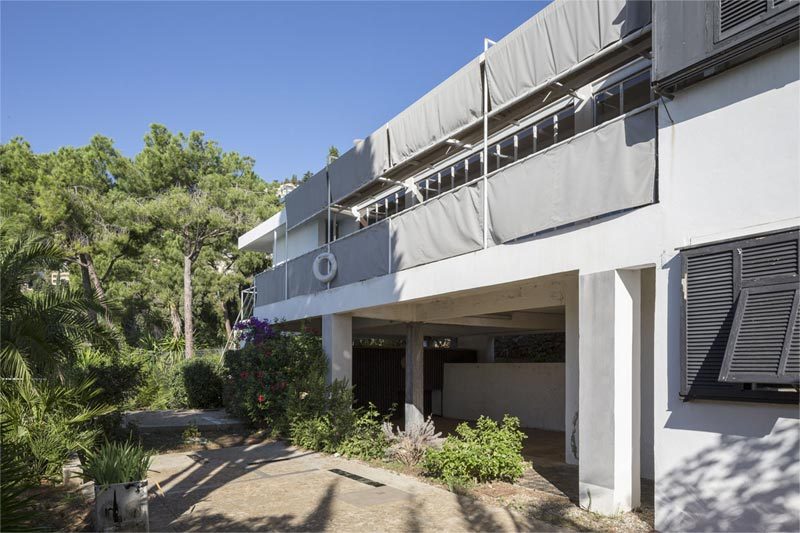
Eileen Gray's E-1027 is one of those buildings that architecture fans know by image before they know by story. The house looks crisp, white, and almost effortless on the Riviera. Its history is not effortless at all. Built between 1926 and 1929, it became a manifesto for a more intimate kind of modern living, then spent decades tangled in authorship myths and the long shadow of more famous men.
That mix is exactly why E-1027 keeps generating attention. It is small enough to feel personal, important enough to reshape design history, and controversial enough to pull in readers who want more than a standard landmark profile.
What E-1027 Actually Was
Cap Moderne, which now cares for the site, describes E-1027 as Gray's first architectural creation and notes that she spent three years designing both the house and its furniture with Jean Badovici involved in the plans. The villa's coded name joined their initials: E for Eileen, 10 for J, 2 for B, and 7 for G.
The house was not large. Cap Moderne states that the main volume measured 120 square meters over two levels, with an open-plan living area above and guest and service spaces below. But Gray used that compact footprint to do something bigger than style. She turned the house into a test of how modern architecture could feel generous, flexible, and lived in.
Why It Still Feels More Human Than Many Modern Icons
What makes E-1027 memorable is not just the white façade or the pilotis. It is the way Gray refused to let modernism become emotionally cold. Cap Moderne's material explains that she used movable partitions, built-in storage, foldaway furniture, and carefully placed thresholds so occupants could be together or apart without friction. The goal was not a machine for living so much as a house that protected privacy, comfort, and choice.
That is also why the nautical language matters. Cap Moderne compares the villa to a liner anchored against the hillside, while the V&A notes that Gray's Transat chair for the house drew on ocean-liner deckchairs. E-1027 does not just face the sea. It borrows the atmosphere of travel, leisure, and air.
How Gray's Role Was Pushed to the Side
The curiosity hook around E-1027 is not invented by social media. It is built into the record. MoMA noted in its Eileen Gray retrospective that Gray had often been left out of design histories and that her contribution to architecture was minimized even though E-1027 was one of her greatest achievements.
The later Le Corbusier episode made that story harder to ignore. Cap Moderne says Gray wanted the villa's walls to remain white, but Le Corbusier stayed there after she had left and painted murals inside in 1938 and 1939. Some were later restored, yet the living-room painting is now concealed to preserve the integrity of Gray's vision. That does not make E-1027 gossip material. It makes it a clear case study in how architectural authorship can be blurred, contested, and corrected.
Why E-1027 Matters Right Now
E-1027 has strong evergreen search value because it connects several reader motives at once: famous architect curiosity, myth correction, travel appeal, interiors, and design lessons. It also feels current because the house rewards a question many readers now ask instinctively: can modern architecture be rigorous without feeling impersonal?
Gray's answer was yes. E-1027 shows that modernism can be light, exacting, and deeply attentive to daily life at the same time. That is why the house still matters, and why its authorship story is worth getting right.
FAQ
What does E-1027 mean?
According to Cap Moderne, the name combines the initials of Eileen Gray and Jean Badovici: E, 10 for J, 2 for B, and 7 for G.
When was E-1027 built?
Cap Moderne dates the house to 1926-1929.
Why is E-1027 controversial?
Part of the debate comes from how Gray's role was minimized in some later histories, and part comes from Le Corbusier's murals, painted in the villa after Gray had left.
Final Thought
E-1027 is not famous only because it is beautiful. It lasts because it proves that architecture history can still change when people look more carefully at who designed what, and why it feels the way it does.
Internal Link Suggestions:
- Link to the Chandigarh post for another case where Le Corbusier's legacy benefits from being read critically rather than worshipfully.
- Link to the Casa Batllo post as a contrast between a highly public icon and a smaller house that built influence through detail.
- Link to the SESC Pompeia post for another architect who made human use more important than formal purity.
Sources Checked:
- https://capmoderne.com/en/lieu/la-villa-e-1027/
- https://capmoderne.com/en/qui_sommes_nous/
- https://www.moma.org/calendar/exhibitions/1797
- https://www.vam.ac.uk/articles/deckchair-design
- https://commons.wikimedia.org/wiki/File%3AE1027_2013_01.jpg
- https://commons.wikimedia.org/wiki/File%3AE1027_2013_02.jpg
- https://capmoderne.com/media/uploads/2015/06/20/villa-archi-3.jpg


Image Download Links:
- https://capmoderne.com/media/uploads/2015/06/20/villa-archi-3.jpg
- https://commons.wikimedia.org/wiki/File%3AE1027_2013_01.jpg
- https://upload.wikimedia.org/wikipedia/commons/5/5a/E1027_2013_01.jpg
- https://commons.wikimedia.org/wiki/File%3AE1027_2013_02.jpg
- https://upload.wikimedia.org/wikipedia/commons/e/e6/E1027_2013_02.jpg


Next Ideas Queue: See next-ideas-queue.md in this folder.
Wikimedia Commons (ver arquivo original).