The TWA Flight Center still feels thrilling because Eero Saarinen turned airport waiting into a choreographed architectural experience instead of dead time.
Matheus Rudo Oliveira · 2026-11-02
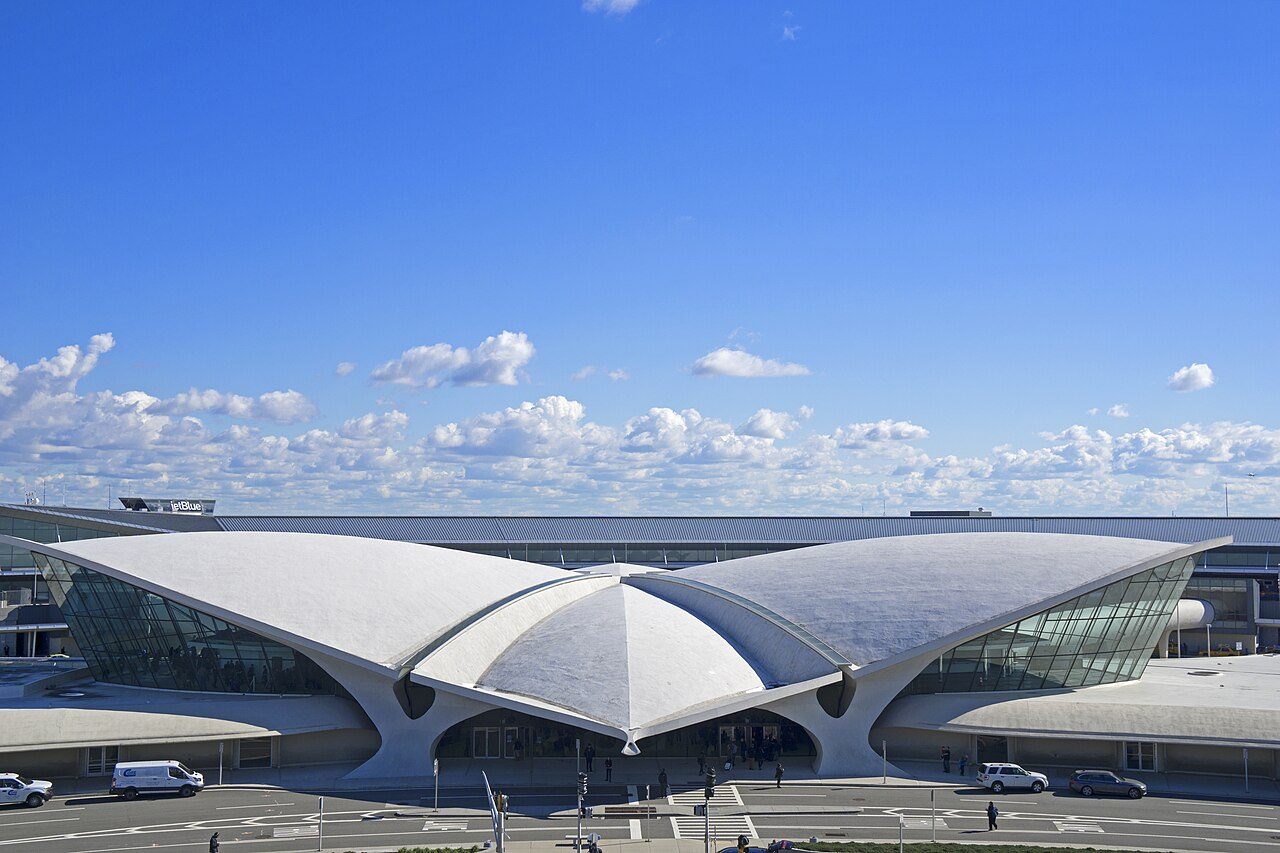
Most airport terminals are designed to make waiting feel tolerable. Eero Saarinen's TWA Flight Center did something far more ambitious: it made waiting feel theatrical. That is still the building's great surprise. Opened in May 1962, the terminal turned a routine travel sequence into architecture with mood, sweep, and a sense of collective performance. Floors rise as if they are already in motion, stairs feel staged rather than merely efficient, and the windows do not just admit light. They frame movement, anticipation, and the fantasy of flight itself.
The Library of Congress HABS record calls the building a masterpiece of expressionist architecture and notes that its use of satellite passenger loading areas was an influential innovation in airport planning. Those are useful historical facts, but the more curious lesson is psychological. The terminal did not rely on spectacle as decoration. It made ritual glamorous. You can feel that in the curved central space, in the way the routes are unfolded, and in the refusal to treat passengers as bodies to be processed invisibly. That is why the building still teaches so well. It understood that infrastructure can be civic theater.
Its afterlife matters too. The landmark designations in 1994 preserved both exterior and interior significance, and the present TWA Hotel reuse works because the building is still publicly legible rather than embalmed. You do not need a hotel reservation to visit the lobby and museum exhibits, which is an unusually important fact for a famous adaptive reuse project. If you are asking who designed it, when it opened, or whether it can still be visited, the answer points to the same enduring idea: Saarinen made air travel feel ceremonial, and the architecture is still strong enough to carry that feeling long after the original airline disappeared.
Wikimedia Commons (ver arquivo original).